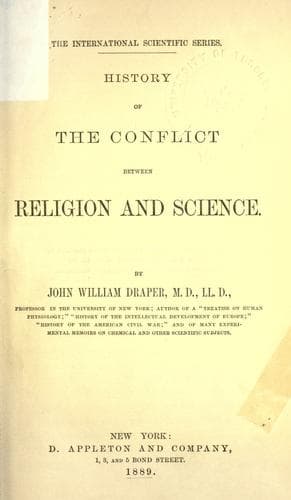
History of the Conflict Between Religion and ScienceDraper, John William
Religion
History of the Conflict Between Religion and Science
Draper, John William
Religion and science -- History
THE PERSIAN CAMPAIGN. The dissensions between Constantinople and
Alexandria had thus filled all Western Asia with sectaries, ferocious
in their contests with each other, and many of them burning with hatred
against the imperial power for the persecutions it had inflicted on
them. A religious revolution, the consequences of which are felt in our
own times, was the result. It affected the whole world.
We shall gain a clear view of this great event, if we consider
separately the two acts into which it may be decomposed: 1. The
temporary overthrow of Asiatic Christianity by the Persians; 2. The
decisive and final reformation under the Arabians.
1. It happened (A.D. 590) that, by one of those revolutions so frequent
in Oriental courts, Chosroes, the lawful heir to the Persian throne, was
compelled to seek refuge in the Byzantine Empire, and implore the aid
of the Emperor Maurice. That aid was cheerfully given. A brief and
successful campaign restored Chosroes to the throne of his ancestors.
But the glories of this generous campaign could not preserve Maurice
himself. A mutiny broke out in the Roman army, headed by Phocas, a
centurion. The statues of the emperor were overthrown. The Patriarch
of Constantinople, having declared that he had assured himself of the
orthodoxy of Phocas, consecrated him emperor. The unfortunate Maurice
was dragged from a sanctuary, in which he had sought refuge; his five
sons were beheaded before his eyes, and then he was put to death. His
empress was inveigled from the church of St. Sophia, tortured, and
with her three young daughters beheaded. The adherents of the massacred
family were pursued with ferocious vindictiveness; of some the eyes were
blinded, of others the tongues were torn out, or the feet and hands cut
off, some were whipped to death, others were burnt.
When the news reached Rome, Pope Gregory received it with exultation,
praying that the hands of Phocas might be strengthened against all his
enemies. As an equivalent for this subserviency, he was greeted with the
title of "Universal Bishop." The cause of his action, as well as of that
of the Patriarch of Constantinople, was doubtless the fact that Maurice
was suspected of Magrian tendencies, into which he had been lured by the
Persians. The mob of Constantinople had hooted after him in the streets,
branding him as a Marcionite, a sect which believed in the Magian
doctrine of two conflicting principles.
With very different sentiments Chosroes heard of the murder of his
friend. Phocas had sent him the heads of Maurice and his sons. The
Persian king turned from the ghastly spectacle with horror, and at once
made ready to avenge the wrongs of his benefactor by war.
Public-domain text, read in full here on John Shaqi.
Reviews
Reviews
No reviews yet
Be the first to share your thoughts on this work.
Elsewhere in the archive
Join the Discussion
Join the discussion
Sign in to leave a comment or review.
Sign InorCreate an account