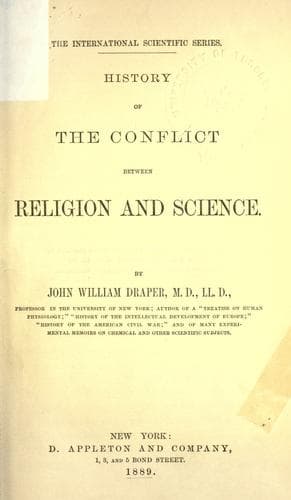
History of the Conflict Between Religion and ScienceDraper, John William
Religion
History of the Conflict Between Religion and Science
Draper, John William
Religion and science -- History
OVERTHROW OF THE PERSIANS. The fall of Jerusalem! the loss of
the metropolis of Christianity! In the ideas of that age the two
antagonistic forms of faith had submitted themselves to the ordeal of
the judgment of God. Victory had awarded the prize of battle, Jerusalem,
to the Mohammedan; and, notwithstanding the temporary successes of the
Crusaders, after much more than a thousand years in his hands it remains
to this day. The Byzantine historians are not without excuse for the
course they are condemned for taking: "They have wholly neglected the
great topic of the ruin of the Eastern Church." And as for the Western
Church, even the debased popes of the middle ages--the ages of the
Crusades--could not see without indignation that they were compelled
to rest the claims of Rome as the metropolis of Christendom on a false
legendary story of a visit of St. Peter to that city; while the true
metropolis, the grand, the sacred place of the birth, the life, the
death of Christ himself, was in the hands of the infidels! It has not
been the Byzantine historians alone who have tried to conceal this great
catastrophe. The Christian writers of Europe on all manner of subjects,
whether of history, religion, or science, have followed a similar
course against their conquering antagonists. It has been their constant
practice to hide what they could not depreciate, and depreciate what
they could not hide.
INVASION OF EGYPT. I have not space, nor indeed does it comport with the
intention of this work, to relate, in such detail as I have given to
the fall of Jerusalem, other conquests of the Saracens--conquests which
eventually established a Mohammedan empire far exceeding in geographical
extent that of Alexander, and even that of Rome. But, devoting a few
words to this subject, it may be said that Magianism received a worse
blow than that which had been inflicted on Christianity; The fate of
Persia was settled at the battle of Cadesia. At the sack of Ctesiphon,
the treasury, the royal arms, and an unlimited spoil, fell into the
hands of the Saracens. Not without reason do they call the battle of
Nehavend the "victory of victories." In one direction they advanced to
the Caspian, in the other southward along the Tigris to Persepolis.
The Persian king fled for his life over the great Salt Desert, from the
columns and statues of that city which had lain in ruins since the night
of the riotous banquet of Alexander. One division of the Arabian army
forced the Persian monarch over the Oxus. He was assassinated by the
Turks. His son was driven into China, and became a captain in the
Chinese emperor's guards. The country beyond the Oxus was reduced.
It paid a tribute of two million pieces of gold. While the emperor
at Peking was demanding the friendship of the khalif at Medina, the
standard of the Prophet was displayed on the banks of the Indus.
Public-domain text, read in full here on John Shaqi.
Reviews
Reviews
No reviews yet
Be the first to share your thoughts on this work.
Elsewhere in the archive
Join the Discussion
Join the discussion
Sign in to leave a comment or review.
Sign InorCreate an account