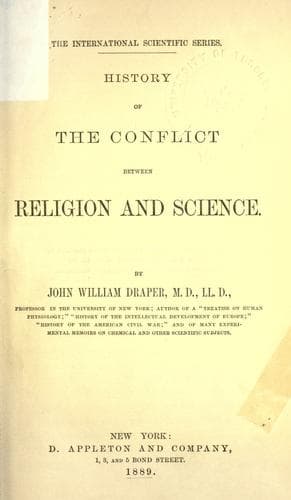
History of the Conflict Between Religion and ScienceDraper, John William
Religion
History of the Conflict Between Religion and Science
Draper, John William
Religion and science -- History
Among the generals who had greatly distinguished themselves in the
Syrian wars was Amrou, destined to be the conqueror of Egypt; for the
khalifs, not content with their victories on the North and East, now
turned their eyes to the West, and prepared for the annexation of
Africa. As in the former cases, so in this, sectarian treason assisted
them. The Saracen army was hailed as the deliverer of the Jacobite
Church; the Monophysite Christians of Egypt, that is, they who, in the
language of the Athanasian Creed, confounded the substance of the
Son, proclaimed, through their leader, Mokaukas, that they desired no
communion with the Greeks, either in this world or the next, that they
abjured forever the Byzantine tyrant and his synod of Chalcedon. They
hastened to pay tribute to the khalif, to repair the roads and bridges,
and to supply provisions and intelligence to the invading army.
FALL OF ALEXANDRIA. Memphis, one of the old Pharaonic capitals, soon
fell, and Alexandria was invested. The open sea behind gave opportunity
to Heraclius to reenforce the garrison continually. On his part, Omar,
who was now khalif sent to the succor of the besieging army the veteran
troops of Syria. There were many assaults and many sallies. In one Amrou
himself was taken prisoner by the besieged, but, through the dexterity
of a slave, made his escape. After a siege of fourteen months, and a
loss of twenty-three thousand men, the Saracens captured the city. In
his dispatch to the Khalif, Amrou enumerated the splendors of the great
city of the West "its four thousand palaces, four thousand baths, four
hundred theatres, twelve thousand shops for the sale of vegetable food,
and forty thousand tributary Jews."
So fell the second great city of Christendom--the fate of Jerusalem had
fallen on Alexandria, the city of Athanasius, and Arius, and Cyril; the
city that had imposed Trinitarian ideas and Mariolatry on the Church.
In his palace at Constantinople Heraclius received the fatal tidings.
He was overwhelmed with grief. It seemed as if his reign was to be
disgraced by the downfall of Christianity. He lived scarcely a month
after the loss of the town.
But if Alexandria had been essential to Constantinople in the supply
of orthodox faith, she was also essential in the supply of daily food.
Egypt was the granary of the Byzantines. For this reason two attempts
were made by powerful fleets and armies for the recovery of the place,
and twice had Amrou to renew his conquest. He saw with what facility
these attacks could be made, the place being open to the sea; he saw
that there was but one and that a fatal remedy. "By the living God, if
this thing be repeated a third time I will make Alexandria as open to
anybody as is the house of a prostitute!" He was better than his word,
for he forthwith dismantled its fortifications, and made it an untenable
place.
Public-domain text, read in full here on John Shaqi.
Reviews
Reviews
No reviews yet
Be the first to share your thoughts on this work.
Elsewhere in the archive
Join the Discussion
Join the discussion
Sign in to leave a comment or review.
Sign InorCreate an account