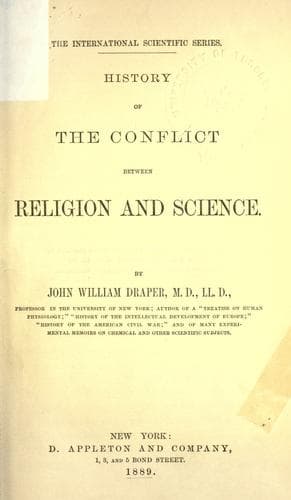
History of the Conflict Between Religion and ScienceDraper, John William
Religion
History of the Conflict Between Religion and Science
Draper, John William
Religion and science -- History
"IN the course of my long life," said the Khalif Ali, "I have often
observed that men are more like the times they live in than they
are like their fathers." This profoundly philosophical remark of the
son-in-law of Mohammed is strictly true; for, though the personal, the
bodily lineaments of a man may indicate his parentage, the constitution
of his mind, and therefore the direction of his thoughts, is determined
by the environment in which he lives.
When Amrou, the lieutenant of the Khalif Omar, conquered Egypt, and
annexed it to the Saracenic Empire, he found in Alexandria a Greek
grammarian, John surnamed Philoponus, or the Labor-lover. Presuming on
the friendship which had arisen between them, the Greek solicited as a
gift the remnant of the great library--a remnant which war and time and
bigotry had spared. Amrou, therefore, sent to the khalif to ascertain
his pleasure. "If," replied the khalif, "the books agree with the Koran,
the Word of God, they are useless, and need not be preserved; if
they disagree with it, they are pernicious. Let them be destroyed."
Accordingly, they were distributed among the baths of Alexandria, and it
is said that six months were barely sufficient to consume them.
Although the fact has been denied, there can be little doubt that Omar
gave this order. The khalif was an illiterate man; his environment
was an environment of fanaticism and ignorance. Omar's act was an
illustration of Ali's remark.
THE ALEXANDRIAN LIBRARY BURNT. But it must not be supposed that the
books which John the Labor-lover coveted were those which constituted
the great library of the Ptolemies, and that of Eumenes, King of
Pergamus. Nearly a thousand years had elapsed since Philadelphus began
his collection. Julius Caesar had burnt more than half; the Patriarchs
of Alexandria had not only permitted but superintended the dispersion
of almost all the rest. Orosius expressly states that he saw the empty
cases or shelves of the library twenty years after Theophilus, the uncle
of St. Cyril, had procured from the Emperor Theodosius a rescript for
its destruction. Even had this once noble collection never endured such
acts of violence, the mere wear and tear, and perhaps, I may add, the
pilfering of a thousand years, would have diminished it sadly.
Though John, as the surname he received indicates, might rejoice in a
superfluity of occupation, we may be certain that the care of a library
of half a million books would transcend even his well-tried powers; and
the cost of preserving and supporting it, that had demanded the ample
resources of the Ptolemies and the Caesars, was beyond the means of a
grammarian. Nor is the time required for its combustion or destruction
any indication of the extent of the collection. Of all articles of
fuel, parchment is, perhaps, the most wretched. Paper and papyrus do
excellently well as kindling-materials, but we may be sure that the
bath-men of Alexandria did not resort to parchment so long as they could
Public-domain text, read in full here on John Shaqi.
Reviews
Reviews
No reviews yet
Be the first to share your thoughts on this work.
Elsewhere in the archive
Join the Discussion
Join the discussion
Sign in to leave a comment or review.
Sign InorCreate an account