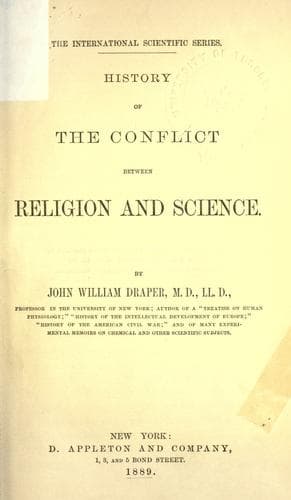
History of the Conflict Between Religion and ScienceDraper, John William
Religion
History of the Conflict Between Religion and Science
Draper, John William
Religion and science -- History
find any thing else, and of parchment a very large portion of these
books was composed.
There can, then, be no more doubt that Omar did order the destruction of
this library, under an impression of its uselessness or its irreligious
tendency, than that the Crusaders burnt the library of Tripoli,
fancifully said to have consisted of three million volumes. The first
apartment entered being found to contain nothing but the Koran, all the
other books were supposed to be the works of the Arabian impostor,
and were consequently committed to the flames. In both cases the story
contains some truth and much exaggeration. Bigotry, however, has often
distinguished itself by such exploits. The Spaniards burnt in Mexico
vast piles of American picture-writings, an irretrievable loss; and
Cardinal Ximenes delivered to the flames, in the squares of Granada,
eighty thousand Arabic manuscripts, many of them translations of
classical authors.
We have seen how engineering talent, stimulated by Alexander's Persian
campaign, led to a wonderful development of pure science under the
Ptolemies; a similar effect may be noted as the result of the Saracenic
military operations.
The friendship contracted by Amrou, the conqueror of Egypt, with John
the Grammarian, indicates how much the Arabian mind was predisposed to
liberal ideas. Its step from the idolatry of the Caaba to the monotheism
of Mohammed prepared it to expatiate in the wide and pleasing fields
of literature and philosophy. There were two influences to which it
was continually exposed. They conspired in determining its path. These
were--1. That of the Nestorians in Syria; 2. That of the Jews in Egypt.
INFLUENCE OF THE NESTORIANS AND JEWS. In the last chapter I have briefly
related the persecution of Nestor and his disciples. They bore testimony
to the oneness of God, through many sufferings and martyrdoms. They
utterly repudiated an Olympus filled with gods and goddesses. "Away from
us a queen of heaven!"
Such being their special views, the Nestorians found no difficulty in
affiliating with their Saracen conquerors, by whom they were treated
not only with the highest respect, but intrusted with some of the most
important offices of the state. Mohammed, in the strongest manner,
prohibited his followers from committing any injuries against them.
Jesuiabbas, their pontiff, concluded treaties both with the Prophet and
with Omar, and subsequently the Khalif Haroun-al-Raschid placed all his
public schools under the superintendence of John Masue, a Nestorian.
Public-domain text, read in full here on John Shaqi.
Reviews
Reviews
No reviews yet
Be the first to share your thoughts on this work.
Elsewhere in the archive
Join the Discussion
Join the discussion
Sign in to leave a comment or review.
Sign InorCreate an account