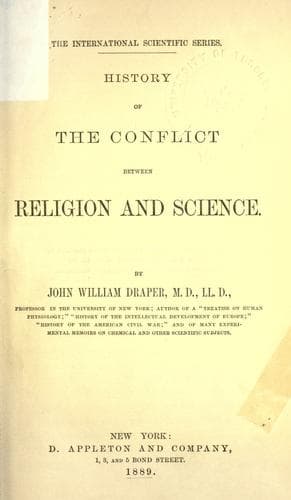
History of the Conflict Between Religion and ScienceDraper, John William
Religion
History of the Conflict Between Religion and Science
Draper, John William
Religion and science -- History
But, since the soul must be regarded as an active principle, to call a
new one into existence out of nothing is necessarily to add to the force
previously in the world. And, if this has been done in the case of every
individual who has been born, and is to be repeated for every individual
hereafter, the totality of force must be continually increasing.
Moreover, to many devout persons there is something very revolting in
the suggestion that the Almighty is a servitor to the caprices and lusts
of man, and that, at a certain term after its origin, it is necessary
for him to create for the embryo a soul.
Considering man as composed of two portions, a soul and a body, the
obvious relations of the latter may cast much light on the mysterious,
the obscure relations of the former. Now, the substance of which the
body consists is obtained from the general mass of matter around us,
and after death to that general mass it is restored. Has Nature, then,
displayed before our eyes in the origin, mutations, and destiny of the
material part, the body, a revelation that may guide us to a knowledge
of the origin and destiny of the companion, the spiritual part, the
soul?
Let us listen for a moment to one of the most powerful of Mohammedan
writers:
"God has created the spirit of man out of a drop of his own light;
its destiny is to return to him. Do not deceive yourself with the vain
imagination that it will die when the body dies. The form you had on
your entrance into this world, and your present form, are not the
same; hence there is no necessity of your perishing, on account of the
perishing of your body. Your spirit came into this world a stranger, it
is only sojourning, in a temporary home. From the trials and tempests
of this troublesome life, our refuge is in God. In reunion with him we
shall find eternal rest--a rest without sorrow, a joy without pain, a
strength without infirmity, a knowledge without doubt, a tranquil and
yet an ecstatic vision of the source of life and light and glory, the
source from which we came." So says the Saracen philosopher, Al-Gazzali
(A.D. 1010).
In a stone the material particles are in a state of stable equilibrium;
it may, therefore, endure forever. An animal is in reality only a form
through which a stream of matter is incessantly flowing. It receives its
supplies, and dismisses its wastes. In this it resembles a cataract,
a river, a flame. The particles that compose it at one instant have
departed from it the next. It depends for its continuance on exterior
supplies. It has a definite duration in time, and an inevitable moment
comes in which it must die.
Public-domain text, read in full here on John Shaqi.
Reviews
Reviews
No reviews yet
Be the first to share your thoughts on this work.
Elsewhere in the archive
Join the Discussion
Join the discussion
Sign in to leave a comment or review.
Sign InorCreate an account