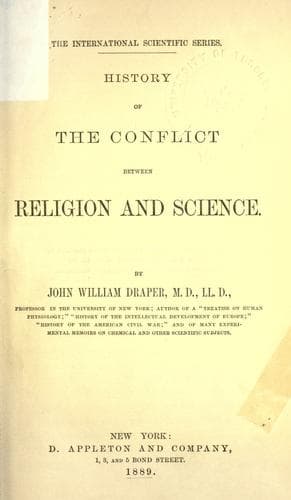
History of the Conflict Between Religion and ScienceDraper, John William
Religion
History of the Conflict Between Religion and Science
Draper, John William
Religion and science -- History
In the great problem of psychology we cannot expect to reach a
scientific result, if we persist in restricting ourselves to the
contemplation of one fact. We must avail ourselves of all accessible
facts. Human psychology can never be completely resolved except through
comparative psychology. With Descartes, we must inquire whether the
souls of animals be relations of the human soul, less perfect members in
the same series of development. We must take account of what we discover
in the intelligent principle of the ant, as well as what we discern in
the intelligent principle of man. Where would human physiology be, if
it were not illuminated by the bright irradiations of comparative
physiology?
Brodie, after an exhaustive consideration of the facts, affirms that
the mind of animals is essentially the same as that of man. Every one
familiar with the dog will admit that that creature knows right from
wrong, and is conscious when he has committed a fault. Many domestic
animals have reasoning powers, and employ proper means for the
attainment of ends. How numerous are the anecdotes related of the
intentional actions of the elephant and the ape! Nor is this apparent
intelligence due to imitation, to their association with man, for
wild animals that have no such relation exhibit similar properties. In
different species, the capacity and character greatly vary. Thus the dog
is not only more intelligent, but has social and moral qualities that
the cat does not possess; the former loves his master, the latter her
home.
Du Bois-Reymond makes this striking remark: "With awe and wonder must
the student of Nature regard that microscopic molecule of nervous
substance which is the seat of the laborious, constructive, orderly,
loyal, dauntless soul of the ant. It has developed itself to its present
state through a countless series of generations." What an impressive
inference we may draw from the statement of Huber, who has written so
well on this subject: "If you will watch a single ant at work, you can
tell what he will next do!" He is considering the matter, and reasoning
as you are doing. Listen to one of the many anecdotes which Huber, at
once truthful and artless, relates: "On the visit of an overseer ant to
the works, when the laborers had begun the roof too soon, he examined it
and had it taken down, the wall raised to the proper height, and a new
ceiling constructed with the fragments of the old one." Surely these
insects are not automata, they show intention. They recognize their old
companions, who have been shut up from them for many months, and exhibit
sentiments of joy at their return. Their antennal language is capable
of manifold expression; it suits the interior of the nest, where all is
dark.
Public-domain text, read in full here on John Shaqi.
Reviews
Reviews
No reviews yet
Be the first to share your thoughts on this work.
Elsewhere in the archive
Join the Discussion
Join the discussion
Sign in to leave a comment or review.
Sign InorCreate an account