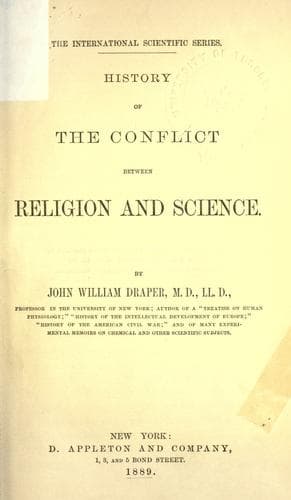
History of the Conflict Between Religion and ScienceDraper, John William
Religion
History of the Conflict Between Religion and Science
Draper, John William
Religion and science -- History
The phantom images of the retina are not perceptible in the light of the
day. Those that exist in the sensorium in like manner do not attract our
attention so long as the sensory organs are in vigorous operation, and
occupied in bringing new impressions in. But, when those organs become
weary or dull, or when we experience hours of great anxiety, or are
in twilight reveries, or are asleep, the latent apparitions have their
vividness increased by the contrast, and obtrude themselves on the
mind. For the same reason they occupy us in the delirium of fevers, and
doubtless also in the solemn moments of death. During a third part of
our life, in sleep, we are withdrawn from external influences; hearing
and sight and the other senses are inactive, but the never-sleeping Mind,
that pensive, that veiled enchantress, in her mysterious retirement,
looks over the ambrotypes she has collected--ambrotypes, for they are
truly unfading impressions--and, combining them together, as they chance
to occur, constructs from them the panorama of a dream.
Nature has thus implanted in the organization of every man means which
impressively suggest to him the immortality of the soul and a future
life. Even the benighted savage thus sees in his visions the fading
forms of landscapes, which are, perhaps, connected with some of his
most pleasant recollections; and what other conclusion can be possibly
extract from those unreal pictures than that they are the foreshadowings
of another land beyond that in which his lot is cast? At intervals he is
visited in his dreams by the resemblances of those whom he has loved
or hated while they were alive; and these manifestations are to him
incontrovertible proofs of the existence and immortality of the soul.
In our most refined social conditions we are never able to shake off the
impressions of these occurrences, and are perpetually drawing from
them the same conclusions that our uncivilized ancestors did. Our more
elevated condition of life in no respect relieves us from the inevitable
operation of our own organization, any more than it relieves us from
infirmities and disease. In these respects, all over the globe men are
on an equality. Savage or civilized, we carry within us a mechanism
which presents us with mementoes of the most solemn facts with which we
can be concerned. It wants only moments of repose or sickness, when the
influence of external things is diminished, to come into full play, and
these are precisely the moments when we are best prepared for the truths
it is going to suggest. That mechanism is no respecter of persons. It
neither permits the haughtiest to be free from the monitions, nor leaves
the humblest without the consolation of a knowledge of another life.
Open to no opportunities of being tampered with by the designing or
interested, requiring no extraneous human agency for its effect,
out always present with every man wherever he may go, it marvelously
Public-domain text, read in full here on John Shaqi.
Reviews
Reviews
No reviews yet
Be the first to share your thoughts on this work.
Elsewhere in the archive
Join the Discussion
Join the discussion
Sign in to leave a comment or review.
Sign InorCreate an account