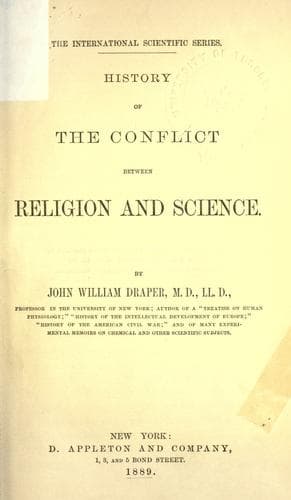
History of the Conflict Between Religion and ScienceDraper, John William
Religion
History of the Conflict Between Religion and Science
Draper, John William
Religion and science -- History
If, after the eyelids have been closed for some time, as when we
first awake in the morning, we suddenly and steadfastly gaze at a
brightly-illuminated object and then quickly close the lids again, a
phantom image is perceived in the indefinite darkness beyond us. We may
satisfy ourselves that this is not a fiction, but a reality, for many
details that we had not time to identify in the momentary glance may
be contemplated at our leisure in the phantom. We may thus make out the
pattern of such an object as a lace curtain hanging in the window, or
the branches of a tree beyond. By degrees the image becomes less and
less distinct; in a minute or two it has disappeared. It seems to have a
tendency to float away in the vacancy before us. If we attempt to follow
it by moving the eyeball, it suddenly vanishes.
Such a duration of impressions on the retina proves that the effect of
external influences on nerve-vesicles is not necessarily transitory.
In this there is a correspondence to the duration, the emergence, the
extinction, of impressions on photographic preparations. Thus, I have
seen landscapes and architectural views taken in Mexico developed, as
artists say, months subsequently in New York--the images coming out,
after the long voyage, in all their proper forms and in all their proper
contrast of light and shade. The photograph had forgotten nothing. It
had equally preserved the contour of the everlasting mountains and the
passing smoke of a bandit-fire.
Are there, then, contained in the brain more permanently, as in the
retina more transiently, the vestiges of impressions that have been
gathered by the sensory organs? Is this the explanation of memory--the
Mind contemplating such pictures of past things and events as have
been committed to her custody. In her silent galleries are there hung
micrographs of the living and the dead, of scenes that we have
visited, of incidents in which we have borne a part? Are these abiding
impressions mere signal-marks, like the letters of a book, which impart
ideas to the mind? or are they actual picture-images, inconceivably
smaller than those made for us by artists, in which, by the aid of a
microscope, we can see, in a space not bigger than a pinhole, a whole
family group at a glance?
Public-domain text, read in full here on John Shaqi.
Reviews
Reviews
No reviews yet
Be the first to share your thoughts on this work.
Elsewhere in the archive
Join the Discussion
Join the discussion
Sign in to leave a comment or review.
Sign InorCreate an account