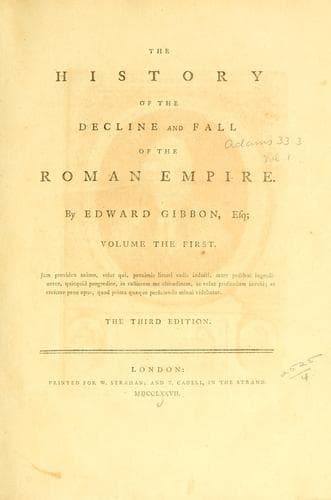
History of the Decline and Fall of the Roman EmpireGibbon, Edward
History
History of the Decline and Fall of the Roman Empire
Gibbon, Edward
Byzantine Empire -- History -- To 527; Rome -- History -- Empire, 30 B.C.-476 A.D.
=======================================================================
DIRECTIONS:
DOUBLE CLICK ON THE "More Files" OPTION AT THE BOTTOM OF THE PG CATALOG
PAGE LISTING TO FIND THE "Files" DIRECTORY. DOUBLE CLICK ON THIS TO OPEN
THE DIRECTORY OF THE AUDIO FILES.
========================================================================
Preface To The Initial Project Gutenberg Edition Of The Audio
Reading Of Edward Gibbon's Decline And Fall Of The Roman Empire.
Or
A First Venue of Excuses, Denials, and Disclaimers.
Let me say at the outset that those who expect this complete audio
rendering of Gibbon's historical and literary masterpiece to be
an epitome of perfect, pear-shaped, dropped -"r" Oxbridge English
may be disappointed. I believe there is such an "audiobook"
edition available commercially, but it isn't free. Experimenting
some years ago with the text-to-speech software then available, I
thought it would be very funny, the private joke of a modern American
barbarian, to have the "little stuffed voices" rendering, in their
innocent and patient way, the imposing yet effervescent bulk of
Gibbon's magnificent and immortal marble-pillared prose. To my
amazement, if not to the credit of my taste, I've found this shotgun
wedding of sound and sense quite harmonious, vital, and durable
through many years of repeated listening. I find that the voices,
unembodied and wooden at first audit, but softer, incarnate,
personalized by acclimatization, pack more expression and clarity
of diction into a few megabytes of software than is exhibited by
most humans I hear these days, except for trained entertainment
professionals and seasoned barroom raconteurs. I propose that the
relentless yet measured deadpan delivery, the ironic contrast of
unwitting voice and worldly wise content, is a plausible fit to the
objective, slightly distant facade of Gibbon's dense and rational,
waste-no-word, 18th century style; a foil to his balanced tone,
restrained despite dudgeon, covering a tale that is, face it, in its
majority, a mordant chronicle, incarnadined--my favorite period
bon mot--by battle, gore, and treachery. Of itself Gibbon's voluminous
tragedy--the framework imposed by historians of his time--allows
us only the occasional adrenal or comic relief by means of an essay
on the basics of Roman jurisprudence, the topography of Arabia, or
the absurdities and impossibilities of early Christian theology,
not to mention the priceless vituperation against the "Greeks" at
the end of Chapter 53.
Public-domain text, read in full here on John Shaqi.
Reviews
Reviews
No reviews yet
Be the first to share your thoughts on this work.
Join the Discussion
Join the discussion
Sign in to leave a comment or review.
Sign InorCreate an account