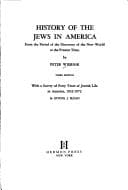
History of the Jews in America: From the Period of the Discovery of the New World to the Present TimeWiernik, Peter
History
History of the Jews in America: From the Period of the Discovery of the New World to the Present Time
Wiernik, Peter
Jews -- America -- History; Jews -- United States -- History
The case of the Jews was making considerable progress, and other
enlightened governments also made representations to Switzerland
in favor of the Jews; still nothing definite was accomplished under
Buchanan’s administration, either. In March, 1861, Rabbi Leeser
expressed, in the “Occident,” his regret, that nothing was done, and
wrote that he expected that nothing would be done until “Switzerland
herself will render the laws harmless by repealing through her Cantonal
Councils all inequality laws existing against us.” This prediction
proved correct; for while the succeeding Secretary of State, William
H. Seward (1801–72) took up the matter with Mr. George G. Fogg, who
was then minister to Switzerland, several years passed before another
favorable report reached the State Department on the subject. The
appointment by the Government of the United States of a Jewish citizen,
Mr. Bernays, as its Consul to Zürich created a stir in both countries,
and clearly indicated the favorable disposition of the administration
of President Abraham Lincoln (1809–65) towards the Jews.
In 1864 Mr. Fogg wrote to Mr. Seward that the President of the
Confederation, Mr. Dubs, had informed him that the Federal Council were
then disposed to so amend the treaty that no discrimination founded
on religious belief should thereafter be made or endured by citizens
of the United States within the limits of the Swiss Confederation.
The remaining Cantons were removing the Jewish disabilities one after
another; but in some of them, as in Basle, the hotbed of opposition and
prejudice against the Jews, full civil rights were not granted until
1872, although the right of residence was freely accorded ten years
earlier. The new Swiss Constitution, which was adopted in 1874, at
last established full religious liberty, and also made the question
of treatments of aliens a Federal, as distinguished from a Cantonal,
matter. It was not until then that the question was solved, so to speak,
automatically; but it is conceded that the efforts of the Government
of the United States contributed to the result, although it could not
attain its object by direct diplomatic negotiations.
PART V.
THE CIVIL WAR AND THE FORMATIVE PERIOD.
CHAPTER XXIV.
THE DISCUSSION ABOUT SLAVERY. LINCOLN AND THE JEWS.
Pro-slavery tendencies of the aristocratic Spaniards and
Portuguese――David Yulee (Levy)――Michael Heilprin and his reply
to Rabbi Raphall’s _Bible View on Slavery_――Immigrants of the
second period as opponents of slavery――Two Jewish delegates in
the Convention which nominated Abraham Lincoln, and one member
of the Electoral College in 1860――Two other Jews officially
participate in Lincoln’s renomination and re-election in
1864――Abraham Jonas――Encouragement from the Scripture in
original Hebrew.
Public-domain text, read in full here on John Shaqi.
Reviews
Reviews
No reviews yet
Be the first to share your thoughts on this work.
Elsewhere in the archive
Join the Discussion
Join the discussion
Sign in to leave a comment or review.
Sign InorCreate an account