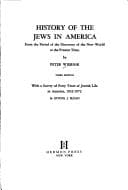
History of the Jews in America: From the Period of the Discovery of the New World to the Present TimeWiernik, Peter
History
History of the Jews in America: From the Period of the Discovery of the New World to the Present Time
Wiernik, Peter
Jews -- America -- History; Jews -- United States -- History
Canon Law on one side and the rise of cities on the other shattered the
position of the Jews until they were reduced to sore straits at the end
of the Middle Ages. The church labored persistently and relentlessly
through the centuries in which Europe was thoroughly Christianized, to
separate the Jews as far as possible from their Gentile neighbors. The
ties which united the two parts of the population by a thousand threads
of mutual interest, friendship, co-operation and beneficial intercourse,
were slowly loosened and, where possible, all but severed. At the
various Church Councils, from Nicea to the last Lateran, there was laid
down the theory of the necessity to force the Jews out of the national
life of the countries in which they dwelt, and to segregate them as
a distinct, inferior and outlawed class. The principles enunciated by
the higher clergy were disseminated by the priests and the demagogues
among the masses. Special laws and restrictions were often followed
by attacks, sacking of the Jewish quarters and degradations of
various kinds. In the twelfth and the following three centuries the
ill-treatment was often followed by expulsions and cancellation of
debts, while heavy fines on individual Jews or on entire communities
were accepted on both sides as a lesser evil or as easy terms for
escaping greater hardships. The climax of this method of dealing with
the Jews, the greatest blow administered to the unhappy Children of
Israel by Christian princes, was the expulsion from Spain in 1492, and
its concomitant, the expulsion from Portugal five years afterwards.
But the Church alone could never have accomplished the ruin of the
Jews if the changing economic conditions and the rise of a large and
powerful class of Christian merchants did not help to undermine the
position of the erstwhile solitary trading class. The burgher classes
were the chief opponents and persecutors of their Jewish competitors:
they seconded, and in many cases instigated, the efforts of the clergy
to exclude the Jews from many occupations. So when the city overpowered
the land owner and began to exert a preponderant influence on the
government, the cause of the Jew was lost, or at least postponed
until a more humane and liberal time, when the ordinary claims of
the brotherhood of man were to overcome the narrow-minded mercantile
and ecclesiastical policies of a ruder age. The great historian Ranke
pointed out that the struggle between the cities and the nobility in
Castille was decided in favor of the former by the marriage of Queen
Isabella to Ferdinand of Aragon. It was also this marriage which sealed
the doom of the Spanish Jews, as well as that of their former friends
and protectors, the Moors, who had by that time sunk so low, that it
was impossible for them to keep their last stronghold in Europe much
longer.
Public-domain text, read in full here on John Shaqi.
Reviews
Reviews
No reviews yet
Be the first to share your thoughts on this work.
Join the Discussion
Join the discussion
Sign in to leave a comment or review.
Sign InorCreate an account