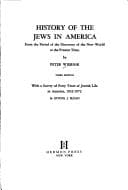
History of the Jews in America: From the Period of the Discovery of the New World to the Present TimeWiernik, Peter
History
History of the Jews in America: From the Period of the Discovery of the New World to the Present Time
Wiernik, Peter
Jews -- America -- History; Jews -- United States -- History
The charitable institutions which were founded or enlarged in this
period were not the only indication of the improved and settled
condition of the Jews who came here in the preceding half century.
These institutions were later to be even more enlarged, and numerous
others were to be established to meet the demands made upon them in
the following quarter century. It is to the synagogues or temples which
date from these times that we have to turn in order to gain a true
conception of the general condition of the Jews. In this respect there
is a striking similarity between the condition of the Sephardim at the
beginning of the nineteenth century and the German Jews at the end of
its third quarter. In both cases the numerical growth almost stopped
with the cessation of immigration from the home country. The small
number of arrivals and the natural increase were barely enough to
replace the losses through death and through estrangements which
were caused by outright defections or by the slower process of mixed
marriages. And just as the Spanish and Portuguese element in American
Judaism, which had barely held its own after the suspension of the
Inquisition, permitted the surviving Marranos to remain where they
were, and improved conditions in Western Europe obviated the necessity
of the Sephardim of Holland, France or England looking for new homes,
so did the much larger and more active German element practically stop
growing numerically after the emancipation of the Jews in the German
States. The number of Jews who arrived here from Germany after 1880
is insignificant, and the same may be said of the relative number of
German-Jewish synagogues which were established after that time.
As a matter of fact the formation of German congregations stopped
several years earlier. The better cohesiveness and discipline among
the Americanized Jews made splits a very rare occurrence. Only in large
cities the removal of many members of a congregation too far from the
location of its synagogue caused the formation of new congregations,
consisting mostly of members of older bodies, with some accessions of
immigrants from the Slavic countries. In the smaller cities there is
even now only one German-American congregation, usually dating from
before the Civil War or from the decade following it. In the larger
cities there may be several of them of about the same age, except in
some communities, like Charleston. S. C., where the Spanish and the
Germans are fused in the one Reform congregation, or in New York, where
each section of the community is sufficiently large to have several
congregations of its own.
Public-domain text, read in full here on John Shaqi.
Reviews
Reviews
No reviews yet
Be the first to share your thoughts on this work.
Elsewhere in the archive
Join the Discussion
Join the discussion
Sign in to leave a comment or review.
Sign InorCreate an account