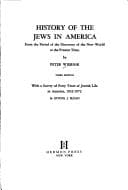
History of the Jews in America: From the Period of the Discovery of the New World to the Present TimeWiernik, Peter
History
History of the Jews in America: From the Period of the Discovery of the New World to the Present Time
Wiernik, Peter
Jews -- America -- History; Jews -- United States -- History
The older synagogues of both Boston, Mass., and Detroit, Mich., date
from the same period. Mount Zion Congregation of St. Paul, Minn.,
was founded in 1871. Meridian, Natchez, Port Gibson and Vicksburg, in
the State of Mississippi, have synagogues which originated within the
decade of the war. The same is true of Kansas City, St. Joseph and
St. Louis, in Missouri, and of Temple Israel of Omaha, Neb. The first
houses of worship of Hoboken and Jersey City, N. J., were established
about 1870, while in the largest city of that state, Newark, the
synagogue (built 1858) of the Congregation B’nai Jeshurun (organized
1848) was replaced by an imposing temple which was dedicated in 1868.
In the State of New York, outside of its chief city, the same can be
seen. The first considerable synagogue of Albany, that of Congregation
Beth El, was erected in 1865. The first congregation of Buffalo,
organized in 1847, built its own synagogue in 1874. In both of these
cities, like in many others, larger and more costly temples were
erected later; but there was much less wealth in the country in general
after the Civil War, and a building costing fifty thousand dollars
which was erected in the “sixties” or the “seventies” represented
perhaps a further advance from preceding times than one three times
as costly indicated in the “nineties.” In some instances, like that
of Rochester, where the first Jewish community was organized in 1848,
the purchase of a spacious church building early in its career (1856)
postponed the necessity of a large edifice until later. It was not
until Rabbi Max Landsberg (b. in Berlin, 1845; a. 1871) had been with
the Congregation “Berith Kodesh” of Rochester for nearly a quarter
century that the present fine temple was erected (1894). In other
communities divisions or splits made it impracticable to build large
houses of worship until a later time; so we find that in Syracuse,
where the first religious organization was formed in 1841, and the
first synagogue was opened in 1846, a building erected in 1850 sufficed
for the needs of the congregation more than half a century afterwards.
This was because a new congregation was formed in 1854; another
secession took place in 1864 and one more congregation was founded in
1870. Brooklyn, on account of its proximity to New York City, could not
develop a really independent communal life until it had a very large
Jewish population, and in some respects has not done so even yet. The
Keap Street Synagogue, which dates from the period which we deal with
in this chapter, was the largest of its kind in the city for many years.
* * * * *
Public-domain text, read in full here on John Shaqi.
Reviews
Reviews
No reviews yet
Be the first to share your thoughts on this work.
Elsewhere in the archive
Join the Discussion
Join the discussion
Sign in to leave a comment or review.
Sign InorCreate an account