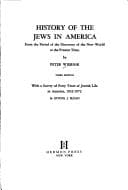
History of the Jews in America: From the Period of the Discovery of the New World to the Present TimeWiernik, Peter
History
History of the Jews in America: From the Period of the Discovery of the New World to the Present Time
Wiernik, Peter
Jews -- America -- History; Jews -- United States -- History
In less than five years after the emancipation of the Russian serfs
there came a crisis, occasioned by the hard times which followed the
crop failure of 1867, which caused “a state of distress in East Prussia
and a famine on the other side of the border.”[43] The Jews of Germany
did much to alleviate the distress of the large number of Russian Jews
who lived at that time in East Prussia, and also to send relief to
the needy co-religionists of Western Russia. But then, as now, the
suffering was too widespread and the general condition too hopeless to
be relieved by almsgiving, and the result was an exodus of considerable
magnitude. This new exodus was treated in a series of articles in the
_Allgemeine Zeitung des Judenthums_ of 1869 entitled “Auswanderung der
Juden aus den Westrussischen Prowinzen” (Emigration of Jews from the
provinces of Western Russia). M. Anatole Leroy-Beaulieu (in his _Les
Immigrants juifs et le Judaisme aux Etats-Unis_, Paris, 1905, p. 5)
tells of 500 Jewish emigrants from Russian-♦Poland which the Alliance
Israelite Universelle sent to the United States in 1869 from the famine
stricken districts. The great anti-Jewish riot in Odessa on Passover,
1871, which shattered the hope of the Jews for emancipation in the then
near future, and marked the beginning of the reaction which culminated
in the reign of the following Czar, was also followed by ♦considerable
emigration of Jews. Many remained in Prussia, which was yet open for
Russian subjects; but a large number proceeded to the United States, or
went there after remaining for some time in England.
The Jewish population of the United States, and especially of the City
of New York, was therefore constantly increasing, though neither the
number of Jews nor the relative proportion as to country of origin is
possible to ascertain for that time. Judge Daly (p. 56) quotes Joseph
A. Scovil, author of “Old Merchants of New York” as saying (in 1868),
“There are now 80,000 Israelites in this city, and it is the high
standard of excellence of the old Israelite merchant of 1800 that has
made the race occupy the proud position it now holds in this city and
in the nation.” Daly himself thought the number to be somewhat smaller.
He says (p. 58), “The Jews have now (1872) in New York twenty-nine
synagogues, and as a proportional part of the population they are now
estimated at about 70,000.”
Public-domain text, read in full here on John Shaqi.
Reviews
Reviews
No reviews yet
Be the first to share your thoughts on this work.
Elsewhere in the archive
Join the Discussion
Join the discussion
Sign in to leave a comment or review.
Sign InorCreate an account