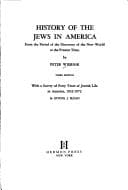
History of the Jews in America: From the Period of the Discovery of the New World to the Present TimeWiernik, Peter
History
History of the Jews in America: From the Period of the Discovery of the New World to the Present Time
Wiernik, Peter
Jews -- America -- History; Jews -- United States -- History
New York
The Jewish Press Publishing Company
1912
Copyright, 1912
By the Jewish Press Publishing Co.
All Rights Reserved
PREFACE.
There were less than ten thousand Jews in the New World three centuries
after its discovery, and about two-thirds of them lived in the West
Indies and in Surinam or Dutch Guiana in South America. While the
communities in those far-away places are now larger in membership than
they were at the beginning of the Nineteenth Century, their comparative
importance is much diminished. The two or three thousand Jews who lived
in North America or in the United States one hundred years ago have,
on the other hand, increased to nearly as many millions, the bulk of
them having come in the last three or four decades. On this account
neither our conditions nor our problems can be thoroughly understood
without the consideration of the actual present. The plan of other
works of this kind, to devote only a short concluding chapter to the
present time, or to leave it altogether for the future historian, could
therefore not be followed in this work. The story would be less than
half told, if attention were not paid to contemporary history.
The chief aim of the work――the first of its kind in this complete
form――being to reach the ordinary reader who is interested in
Jewish matters in a general way, original investigations and learned
disquisitions were avoided, and it was not deemed advisable to
overburden the book with too many notes or to provide a bibliographical
apparatus. The plan and scope of the work are self evident; it was
inevitable that a disproportionately large part should be devoted to
the United States. The continuity of Jewish history is made possible
only by the preservation of our identity as a religious community;
local history really begins with the formation of a congregation. Each
of the successive strata of immigration was originally represented
by its own synagogues, and when the struggle to gain a foothold or to
remove disabilities was over, communal activity was the only one which
could properly be described as Jewish. Economic growth could have been
entirely neglected, despite the present day tendency to consider every
possible problem from the standpoint of economics. But the material
well-being of the Jews of the earlier periods was an important factor
in the preparation for the reception and easy absorption of the larger
masses which came later, and this gives wealth a meaning which, in the
hands of people who are less responsible for one another than Jews,
it does not possess. The Marrano of the Seventeenth or the Eighteenth
Century who brought here riches far in excess of what he found among
the inhabitants in the places where he settled, would probably not
have been admitted if he came as a poor immigrant, and his merit as a
pioneer of trade and industry interests us because he assisted to make
this country a place where hosts of men can come and find work to do.
Public-domain text, read in full here on John Shaqi.
Reviews
Reviews
No reviews yet
Be the first to share your thoughts on this work.
Join the Discussion
Join the discussion
Sign in to leave a comment or review.
Sign InorCreate an account