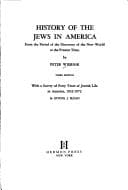
History of the Jews in America: From the Period of the Discovery of the New World to the Present Time — John Shaqi
History of the Jews in America: From the Period of the Discovery of the New World to the Present TimeWiernik, Peter
History
History of the Jews in America: From the Period of the Discovery of the New World to the Present Time
Wiernik, Peter
Jews -- America -- History; Jews -- United States -- History
Not so in Spain. The Jewish merchant who could no longer hold his own
against his stronger non-Jewish competitor, could do what is often
done by others who voluntarily retire from such pursuits, i. e., invest
his capital in landed estates. We can imagine that the transition did
not at all seem to be forced, that those who caused it, and even its
victims, might have considered it as the natural course of events.
After the great massacres of 1391, a century before the expulsion, many
Jews emigrated to Moorish North Africa, where there still remained some
degree of tolerance and friendliness for them, mingled perhaps with
some hope of re-conquering the lost parts of the Iberian peninsula. But
later there was less thought of migration, least of all of emigrating
to the parts of Spain which still remained in the possession of the
Moors. The race which was, seven centuries before, assisted by the
Jews to become masters of Iberia, and which together with them rose to
a height of culture and mental achievement which is not yet properly
appreciated in modern history, has now become degenerate and almost
savage in its fanaticism. The Jew of Spain was still proud, despite
his sufferings. He could not see his fate as clearly as we can now from
the perspective of five hundred years. He was rooted in the country in
which he lived for many centuries. He was, like most men of wealth and
position, inclined to be optimistic, and he could not miss his only
possible protection against expropriation or exile――the possession of
full rights of citizenship――because the Jews nowhere had it in those
times and had not had it since the days of ancient Rome.
The catastrophe of the great expulsion, which came more unexpectedly
than we can now perceive, was possibly facilitated by the position
which the Jews held as land owners. It certainly contributed to make
the decree of exile irrevocable. The holder of real property is more
easily and more thoroughly despoiled, because he cannot hide his most
valuable possessions or escape with them. He is not missed when he
is gone; his absence is hardly felt after the title to his lands has
been transferred to the Crown or to favorites of the government. When
the robbery is once committed only compunction or an awakened sense of
justice could induce the restitution which re-admission or recall would
imply. And as abstract moral forces had very little influence in those
cruel days, it is no wonder that the expulsion was final――the only one
of that nature in Christian Europe.
Public-domain text, read in full here on John Shaqi.
Reviews
Reviews
No reviews yet
Be the first to share your thoughts on this work.
Join the Discussion
Join the discussion
Sign in to leave a comment or review.
Sign InorCreate an account