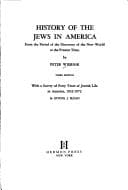
History of the Jews in America: From the Period of the Discovery of the New World to the Present TimeWiernik, Peter
History
History of the Jews in America: From the Period of the Discovery of the New World to the Present Time
Wiernik, Peter
Jews -- America -- History; Jews -- United States -- History
But the large majority of the Jewish laborers had enough of Socialism
by the time they were entitled to citizenship; the number of voters of
that party increased very slowly, and, like the above-mentioned case of
the unions, they were not the same from year to year. While the Jewish
population was increasing rapidly in some parts of New York and other
large cities, and the number of non-Jewish, or rather non-immigrant,
voters in some districts became very small or practically disappeared,
the number of Socialist votes was fluctuating, and never became a
majority or even a plurality in a district. While the leaders were
preaching that all opportunities were now gone and all avenues of
advancement were closed for the poor man, every individual among their
followers was struggling to raise himself above his surroundings.
Americanization meant the abandonment of extreme views on all subjects,
and the naturalized immigrant, even when he remained a manual worker,
was soon voting for one of the two great American parties. He still
retained a leaning towards radical reform, for the Russian mind is much
inclined to theorizing; but he would now seldom go further than support
an American reformer or join one of the movements instituted by the
better elements for the purpose of purifying city governments. But
as the reform element usually signalizes its accession to power by a
severe enforcement of Sunday-closing laws and other interferences with
personal liberty which smack of persecution, the immigrant Jew usually
joins the other disappointed classes to turn the reformers out of
office at the next election.
There was a slow and steady turning away from the dry and monotonous
radical literature of that period, which was a counterpart of the
turning away from extreme politics. In one respect the change in
literary tastes or requirements amounted to a revulsion――one might
almost say, to a revolution. The first attempt to publish in Yiddish
a sensational novel in weekly or semi-weekly installments, popularly
known as “Heften,” which was made in New York about 1890, met with
extraordinary success. The number of such ventures soon multiplied,
and the sales were large in other cities as well as in the place
of publication. The Yiddish periodical press became endangered, but
it saved――and revenged――itself by beginning to publish one, two and
sometimes as much as three serial stories in daily installments, a
practice which in a short time ruined the business of the “Heften.”
Public-domain text, read in full here on John Shaqi.
Reviews
Reviews
No reviews yet
Be the first to share your thoughts on this work.
Elsewhere in the archive
Join the Discussion
Join the discussion
Sign in to leave a comment or review.
Sign InorCreate an account