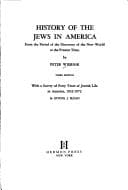
History of the Jews in America: From the Period of the Discovery of the New World to the Present TimeWiernik, Peter
History
History of the Jews in America: From the Period of the Discovery of the New World to the Present Time
Wiernik, Peter
Jews -- America -- History; Jews -- United States -- History
Fortunately for France, for civilization and for the Jews,
anti-Semitism was utterly defeated in the open political combat for
the first time in modern history. The barrier erected by Liberty proved
sufficiently strong to stem the tide of raging injustice; the very
excitement caused by the wrong was the best warning against the danger
which the revival of medieval bigotry brings to an enlightened country.
Persecution and discrimination were again forced back and confined
to the more shady corners of the earth, to the countries where the
masses of the people are still oppressed by tyranny and handicapped
by ignorance. It was in these countries that the Dreyfus agitation was
seized upon by the enemies of the Jews and exploited to the ♦utmost
extent, and it was there that many Jews began to despair. If France
could become anti-Semitic at the end of the nineteenth century, what
hope was there for the Jew in the backward countries, in political
progress and cultural development? The full force of the victory over
the French reactionaries was known and felt only in the free countries;
elsewhere the impression remained that the Jews of France remained in a
lamentable position, and that the future looked as gloomy to them as is
usually the case in Russia after a new outbreak of anti-Jewish riots.
The result of this new hopeless view of the Jewish situation was
the sudden spread of the new Zionist movement, which was inaugurated
about that time on the Continent by Dr. Theodore Herzl (1860–1904). He
and his first supporters were Austrians, they obtained their largest
following in Russia and Galicia, and in the large cities in other
countries where there were numbers of Jewish Immigrants from slavic
countries. When the movement began to show signs of life in the English
speaking countries, native or assimilated Jews joined it and became
its leaders. And so it came to pass that although the American press,
with few and unimportant exceptions, was as strongly pro-Dreyfus as
the Jewish press itself, and the victory of Justice and liberalism was
as much emphasized here as in Paris, a limited field was prepared here
for the Zionist movement, as well as in Russia, Austria and Roumania.
The old “Chowewe Zion,” or believers in the colonization of Palestine,
joined the new political movement here, as they did abroad, and the
“Maskilim,” or Germanized Hebrew scholars, who were forced to the
background by the advent of the popular radical leaders of the new
period of immigration, were also attracted by the new movement which
helped to restore the equilibrium among the intellectual Jewish classes.
The first Zionist societies of New York consisted almost entirely of
immigrants. But when the “Federation of Zionist Societies of Greater
New York and Vicinity” (organized 1897) expanded by absorbing societies
outside of New York, and became, at a convention held in New York in
July, 1898, the “Federation of American Zionists,” American Jews were
Public-domain text, read in full here on John Shaqi.
Reviews
Reviews
No reviews yet
Be the first to share your thoughts on this work.
Elsewhere in the archive
Join the Discussion
Join the discussion
Sign in to leave a comment or review.
Sign InorCreate an account