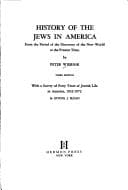
History of the Jews in America: From the Period of the Discovery of the New World to the Present Time — John Shaqi
History of the Jews in America: From the Period of the Discovery of the New World to the Present TimeWiernik, Peter
History
History of the Jews in America: From the Period of the Discovery of the New World to the Present Time
Wiernik, Peter
Jews -- America -- History; Jews -- United States -- History
Jacob Barsimson and Asser Levy (d. 1682) petitioned to be allowed
to stand guard like other burghers, or to be relieved from the tax,
which was refused by the Governor and Council with the remark that
“they might go elsewhere if they liked.” But after the last order
from Amsterdam favorable to the claims of the Jews was received, Asser
Levy applied to be admitted to the right of citizenship, and exhibited
his certificate to the court to show that he had been a burgher in
Amsterdam. His request, as well as the one made for the same purpose
by Salvatore d’Andrade and others, was not complied with. The matter
was brought before the Governor and Council, and as the directions
from Holland were controlling, an order was made April 21, 1657, that
the Burgomaster should admit them to that privilege. Here the struggle
virtually ended, and they were no longer troubled during the Dutch rule.
When the British captured the city in 1664 and renamed it New York, the
condition of the Jews remained practically unchanged. There is a record
of at least one Jew who removed from Newport to New York in that period,
and had difficulties with the local authorities because they enforced
against him the regulation which did not permit a Jew to engage in
retail trade. The Charter of Liberties and Privileges which was adopted
in 1683 by the colonial legislature declared that “no one should be
molested, punished, disquieted or called in question for his religious
opinion, who professed faith in God by Jesus Christ,” which meant
that the Jews and unbelievers were excluded from the privileges of
religious freedom. A petition by the Jews to Governor Dongan, in 1686,
for liberty to exercise their religion, i. e., to have public worship,
was consequently decided in the negative. But James, Duke of York
(afterwards King James II., 1633–1701), to whom New York was granted by
his brother, had previously sent out instructions, which arrived about
that time, “to permit all persons of what religion soever, quietly to
inhabit within the government, and to give no disturbance or disquiet
whatsoever for or by reason of their differing in matters of religion.”
Public-domain text, read in full here on John Shaqi.
Reviews
Reviews
No reviews yet
Be the first to share your thoughts on this work.
Join the Discussion
Join the discussion
Sign in to leave a comment or review.
Sign InorCreate an account