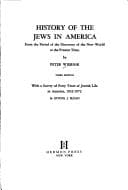
History of the Jews in America: From the Period of the Discovery of the New World to the Present TimeWiernik, Peter
History
History of the Jews in America: From the Period of the Discovery of the New World to the Present Time
Wiernik, Peter
Jews -- America -- History; Jews -- United States -- History
The affectionate expressions of your address again excite my
gratitude and receive my warmest acknowledgment.
The power and goodness of the Almighty, so strongly manifested
in the events of our late glorious revolution, and His kind
interposition in our behalf, have been no less visible in
the establishment of our present equal government. In war He
directed the sword, and in peace He has ruled in our councils.
My agency in both has been guided by the best intentions and a
sense of duty I owe to my country.
And as my intentions have hitherto been amply rewarded by the
approbation of my fellow-citizens, I shall endeavor to deserve a
continuance of it by my future conduct.
May the same temporal and eternal blessing which you implore for
me rest upon your congregations.
G. WASHINGTON.
CHAPTER XIV.
OTHER COMMUNITIES IN THE FIRST PERIODS OF INDEPENDENCE.
Rabbi Gershom Mendez Seixas――Growth of the Jewish community
of Philadelphia on account of the War――Protest against the
religious test clause in the Constitution of Pennsylvania――
Benjamin Franklin contributes five pounds to Mickweh Israel――
Secession of the German-Polish element――New Societies――Jewish
lawyers; Judge Moses Levy――Congressman H. M. Phillips――The
Bush family of Delaware――New Jersey and New Hampshire――North
Carolina: the Mordecai family and other early settlers.
While the Jewish community of New York was not entirely dispersed, like
that of Newport, by the outbreak of the Revolution, a great majority
resolved to leave the city before it was occupied by the British
(Sept. 15, 1776). The patriotic minister of the Congregation Shearit
Israel, Rabbi Gershom Mendez Seixas (b. in New York, 1745; d. there
July 2, 1816), who was the spiritual head of the community since 1766,
early espoused the cause of the colonies, and it was mostly due to his
influence that the congregation closed the door of its Synagogue on the
approach of the British. Most of those who left went to Philadelphia;
Rabbi Seixas himself first went to Stratford, Conn., where he remained
about four years, and where several of his former congregants joined
him. In 1780 he, too, went to Philadelphia, but returned to New York
after the war (March, 1784), when the Synagogue was reopened and
he resumed his former position. He later (1787) became a trustee of
Columbia College, and was one of its incorporators whose name appeared
on the charter.
Public-domain text, read in full here on John Shaqi.
Reviews
Reviews
No reviews yet
Be the first to share your thoughts on this work.
Elsewhere in the archive
Join the Discussion
Join the discussion
Sign in to leave a comment or review.
Sign InorCreate an account