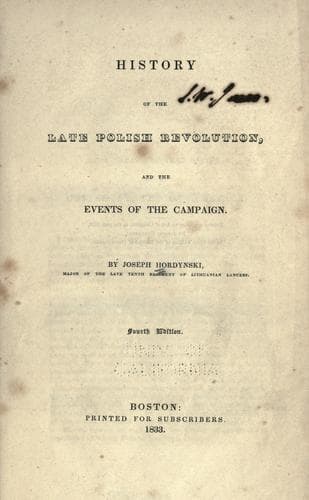
History of the Late Polish Revolution and the Events of the CampaignHordynski, Joseph
History
History of the Late Polish Revolution and the Events of the Campaign
Hordynski, Joseph
Poland -- History -- Revolution, 1830-1832
The moment that the work of reconstructing the bridges was to be put
in execution, was to be decided by the time and the direction in
which the fire of general Prondzynski should be heard. If the latter
general should succeed on the enemy's flank, then, of course, the
bridges were to be reconstructed, if not, they were to remain in their
present state to obstruct the passage of the enemy. Several hours
were occupied by this fire of artillery, and slight manoeuvres of the
light troops, when at last, between eight and nine o'clock, the fire
of general Prondzynski was heard, who had evidently passed Wodynie,
and had begun acting on the enemy's flank. This was the signal to
commence repairing the bridges. General Skrzynecki, with his suite,
superintended the work, and several battalions were employed in
bringing together the materials. A degree of consternation was observed
in the enemy's forces, in consequence of the attack on his flank, and
his columns began a movement; but his artillery continued in their
position, and commenced a terrible fire upon our men who were engaged
in reconstructing the bridges. The presence of mind, however, of the
general in chief, who exposed himself at the most dangerous points,
encouraged the men to persevere in their labors under this destructive
fire of artillery.[53] When the fire on his flank was at its height,
the enemy began to withdraw his artillery, and commenced a retreat. By
between 10 and 11 o'clock no part of the enemy's forces were remaining
upon the plain of Boimie; but, although the work of repairing the
bridges was pressed to the utmost, it was near two o'clock before they
could be brought to such a state as to admit the passage of artillery;
and although several battalions of the infantry had passed over before
this, they were not able, without too much exposure, to overtake the
enemy, who was in rapid retreat, leaving his cavalry as a rear guard.
It was not until the last mentioned hour, that the whole division
passed the bridges, and pressed forward at a rapid pace in the pursuit,
the cavalry advancing upon the trot. While this was taking place upon
the great road to Boimie, general Prondzynski [_Plan_ XXI, (A),]
who, according to his instructions, advanced to Wodynie, found there
a division of sixteen squadrons of Russian cavalry, whom he drove
from their position: he pursued them in the direction of Siedlce, and
reached the environs of Iganie, where he saw the corps of Rosen and
Giesmar (B) in full retreat. At this moment the position of general
Prondzynski was also critical; for, as the reader is already aware,
our main army was not in a condition to follow the enemy, on account
of the obstruction from the broken bridges. If the enemy had thrown
himself upon Prondzynski, they could have crushed him, and with their
other forces could have safely passed the dyke (_a_) at Iganie, before
our main forces, retarded as they were, could have arrived. This danger
Public-domain text, read in full here on John Shaqi.
Reviews
Reviews
No reviews yet
Be the first to share your thoughts on this work.
Elsewhere in the archive
Join the Discussion
Join the discussion
Sign in to leave a comment or review.
Sign InorCreate an account