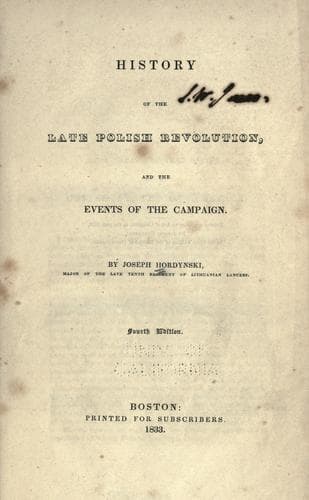
History of the Late Polish Revolution and the Events of the CampaignHordynski, Joseph
History
History of the Late Polish Revolution and the Events of the Campaign
Hordynski, Joseph
Poland -- History -- Revolution, 1830-1832
To these circumstances, is to be added that at this time the other
cabinets began to feel dissatisfied at the course of Russia, and
decidedly refused the requests of aid in men and money which she made
on the pretext of former treaties. Every thing, in fine, seemed to
promise a near end of the present difficulties. The Polish army, to
whom this state of things was well known, waited impatiently for the
moment of a decisive contest. One victory more, and the Russians would
not be in a state to push their attempts farther. Nothing could then
stop the progress of our arms, which would rest on the borders of the
Dnieper, the only frontier known to our ancestors. One struggle more,
and the darkness of ages, which had hung over the Polish provinces
of the North, would be dispersed. The light of civilization would
then spread its rays as far as the Ural mountains, and with that
civilization a new happiness would cheer those immense regions. Upon
the borders of the Dnieper fraternal nations would hold out their hands
towards us, and there would be made the great appeal: 'Russians! why
all this misery? The Poles wish to deprive you of nothing. Nay, they
have even sacrificed their children for your good. Russians! awake to
a sense of your condition! You, like us, are only the unhappy victims
of the relentless will of those who find their account in oppressing
you and us. Let us end this struggle, caused by despotism alone. Let it
be our common aim to rid ourselves of its cruel power. It is despotism
alone that we have any interest in fighting against. Let us mark these
frontiers, which so much fraternal blood has been shed to regain,
by monuments, that shall tell posterity, that here ended forever
the contest between brothers, which shall recall the disasters that
despotism has caused, and be a memorial of eternal friendship between
us, and of eternal warning to tyranny.'
A COMPARATIVE VIEW OF THE FORCE OF THE TWO ARMIES AFTER THE BATTLE OF
IGANIE.
The Russian forces, which commenced the contest on the 10th of
December, amounted, as has been before stated, to about 200,000 men and
300 pieces of cannon. That army received two reinforcements, viz. the
corps of general prince Szachowski, consisting of 20,000 men, and 36
pieces of cannon; and the corps of the imperial guard, consisting also
of 20,000 men and 36 pieces of cannon. The whole Russian force, then,
which had fought against us, amounted to 240,000 men, and 372 pieces of
cannon.
Public-domain text, read in full here on John Shaqi.
Reviews
Reviews
No reviews yet
Be the first to share your thoughts on this work.
Elsewhere in the archive
Join the Discussion
Join the discussion
Sign in to leave a comment or review.
Sign InorCreate an account