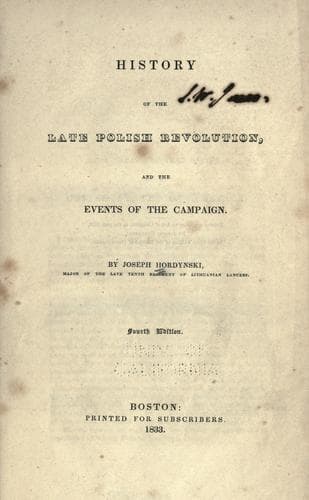
History of the Late Polish Revolution and the Events of the CampaignHordynski, Joseph
History
History of the Late Polish Revolution and the Events of the Campaign
Hordynski, Joseph
Poland -- History -- Revolution, 1830-1832
To act against this force, our army, counting the reinforcements of
6000 men which it received before the battle of Grochow, had in service
about 50,000 men, and about 100 pieces of cannon. Up to the battle
of Iganie, fifteen principal battles had been given, viz. those of
Stoczek, Dobre, Milosna, Swierza and Nowawies, Bialolenka (on the 20th
and 24th), Grochow (on the 20th and 25th), Nasielsk, Pulawy, Kurow,
Wawr (on the 18th and 31st), Dembe-Wielkie and Iganie. To these are
to be added a great number of small skirmishes, in not one of which
could it have been said that the Russians were successful. By their
own official reports,--after the battle of Grochow, more than fifty
thousand Russians were _hors du combat_. It will not, then, be an
exaggeration to say, that their whole loss, taking into the account
prisoners and those who fell under the ravages of the cholera, which
had begun to extend itself in their army, must have amounted to between
80,000 and 100,000 men.[54] From the enormous park of artillery which
the Russians had brought against us, they lost as many as sixty
pieces. It may then be presumed that the Russian army remained at
between 130,000 and 150,000 men, and about 240 pieces of cannon, not
estimating, however, which it would be impossible to do, the number
of cannon which might have been dismounted. Our army, which was
reorganized at Warsaw, after its losses, was brought to about the same
state as at the commencement of the war, that is, about 40,000 strong.
The artillery was now augmented to 140 pieces.
Although the enemy's force was still sufficiently imposing, the reader
will permit me to say, (and in fact we did reasonably calculate thus)
that as we had fought with such success against the enemy in his
unimpaired strength, we might with confidence promise ourselves a
certain issue of the conflict in our favor, when, with his forces thus
diminished in numbers, sick, discouraged, and discontented, we could
meet him with the same and even a stronger force than that with which
we had already been victorious, animated too, as we now were, by the
inspiriting influence of our past success, and aided by the terror with
which our arms had inspired the enemy.
FOOTNOTES:
Public-domain text, read in full here on John Shaqi.
Reviews
Reviews
No reviews yet
Be the first to share your thoughts on this work.
Elsewhere in the archive
Join the Discussion
Join the discussion
Sign in to leave a comment or review.
Sign InorCreate an account