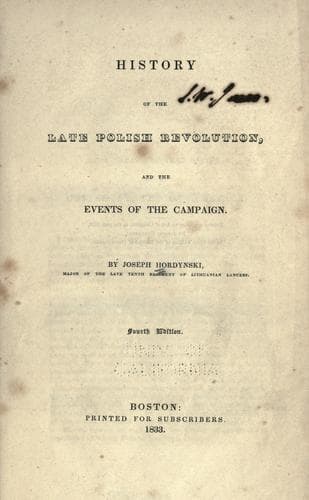
History of the Late Polish Revolution and the Events of the CampaignHordynski, Joseph
History
History of the Late Polish Revolution and the Events of the Campaign
Hordynski, Joseph
Poland -- History -- Revolution, 1830-1832
It was mid-day when the Russians (_c_) (_d_) debouched from the forest,
commenced their advance, and deployed upon the plain under the fire
of our artillery, which was opened immediately. Some fifty pieces of
the enemy's artillery, (_e_) approached the city, took position, and
commenced their fire. As the town was occupied by so small a force,
and so distributed as not to be affected by the enemy's fire, he was
permitted to continue this fire, and our artillery reserved theirs for
the moment when he should make a general advance to storm the town.
This soon took place. An enormous mass of infantry (_f_) advanced to
the assault. Our light troops evacuated the part of the town beyond
the river, to enable our artillery to open upon it. That part was
immediately occupied by the enemy, who, crowded together in the
streets, were subjected to a fire which spread death among their ranks.
The enemy hesitated whether to advance or retire, and remained in the
utmost disorder, falling under the fire of our artillery and the torn
and burning fragments of the wooden buildings which were rent in pieces
by that fire. While the enemy remained in this horrible suspense, the
brave colonel Oborski led his regiment to the charge, and bore down
all before him. A most terrible massacre, at the point of the bayonet,
then took place in the Square of the Church (_g_), where great masses
of the enemy were crowded together. The Russians were driven out of
the town after a most severe loss. They were left at liberty to take
possession of the same part again, but they did not repeat their
attacks upon the town, satisfying themselves with concentrating a heavy
fire of artillery principally upon the heights occupied by our own.
This state of things continued till three o'clock, when general Gielgud
gave orders to evacuate the position, agreeably to the directions of
the general in chief. Sixteen squadrons of cavalry were left to cover
the movement, and in this way our division, reaching the village of
Stoiadly, two English miles distant, took a second position there.
This new position was advantageous, on account of the elevation of
the ground. Our right wing, in particular, was well supported upon a
thick marshy forest, and was pushed forward far enough to give a cross
fire to the enemy, in case he should try to force the passage of the
great road. As the enemy was so imprudent, after our evacuation, as to
commence his debouchment through the town, with his cavalry in advance,
he exposed himself to a severe loss; for our artillery, consisting
of six pieces, poured a destructive fire upon the main street of the
city, which led to the only passage over the river; and again, after
deploying under this fire upon the plain, he was subjected to vigorous
charges from our cavalry under Skarzynski, which cost him a severe
loss, and delayed his advance for more than half an hour. As the space
between Stoiadly and Minsk was a plain gently descending from our side,
Public-domain text, read in full here on John Shaqi.
Reviews
Reviews
No reviews yet
Be the first to share your thoughts on this work.
Elsewhere in the archive
Join the Discussion
Join the discussion
Sign in to leave a comment or review.
Sign InorCreate an account