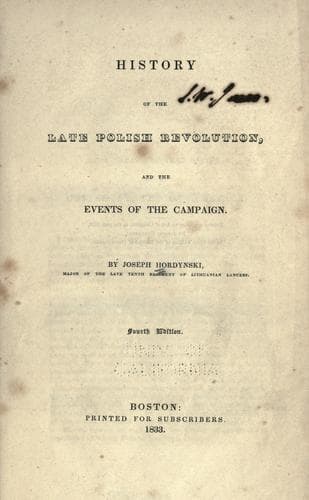
History of the Late Polish Revolution and the Events of the CampaignHordynski, Joseph
History
History of the Late Polish Revolution and the Events of the Campaign
Hordynski, Joseph
Poland -- History -- Revolution, 1830-1832
moist in the lower parts, and in every way favorable for attacks by
our cavalry, their charges were continually repeated, and the combat
on this plain deserved the name of the combat of cavalry. To give the
reader an idea of these effective charges against a cavalry of much
superior force, I will merely state that each squadron of the sixteen,
was engaged some three or four successive times with the enemy. Their
horses were continually in foam. The regiment of Zamoyski, the Krakus,
and the 5th Hulans greatly distinguished themselves. The loss of the
enemy's cavalry, of which the greater part consisted of regiments of
heavy dragoons, was very great. Their horses hoofs sunk into the humid
ground, and our Krakus, on their light animals, assaulted them in the
very midst of their ranks. Many staff and other officers of the enemy
were left dead upon the field. Our advanced guard having, in this way,
fought with such advantages, against the whole Russian army, at Minsk
and Stoiadly, from mid-day until 5, P.M.; the general in chief ordered
them to evacuate their position as promptly as possible, and retire to
Dembe-Wielke, where he awaited the enemy in order of battle, and where
he was desirous of meeting his attack before night. This movement was
executed without molestation from the Russians. Our advanced guard
passed the forests between Dembe-Wielke and Stoiadly, and arrived at
the position of Dembe-Wielke, where fifty pieces of our artillery
were posted to receive the enemy, and our whole force took the order
of battle. The enemy, however, did not debouch from the forests, but
remained on the other side. This finishes the details of that day and
of the battle of Minsk, in which the early cessation of the attacks of
the enemy proved how much he had suffered. He had two generals mortally
wounded, general Pahlen and the prince Galiczyn, and lost nearly 4,000
men. On our side the loss was four or five hundred only.
For their conduct in this battle, the National Government and the
general in chief presented their thanks to the 2d division under
Gielgud and the division of cavalry under Skarzynski. General Gielgud
was advanced to the rank of general of division, and it was perhaps
owing to his skilful dispositions and brave conduct on that day, that
it was not feared to entrust him with the command of the all important
expedition to Lithuania.
On the 27th and 28th, no events took place. During the night of the
28th, the enemy, to our astonishment, evacuated his position and
retired as far as Kaluszyn, twenty-four English miles distant. We
cannot give the true cause of this sudden and unexpected retreat.
Perhaps it was on account of a failure of provisions. Another cause
might have been the rumors, which had begun to take an aspect of
importance, of the revolutions in Lithuania and Samogitia.
Public-domain text, read in full here on John Shaqi.
Reviews
Reviews
No reviews yet
Be the first to share your thoughts on this work.
Elsewhere in the archive
Join the Discussion
Join the discussion
Sign in to leave a comment or review.
Sign InorCreate an account