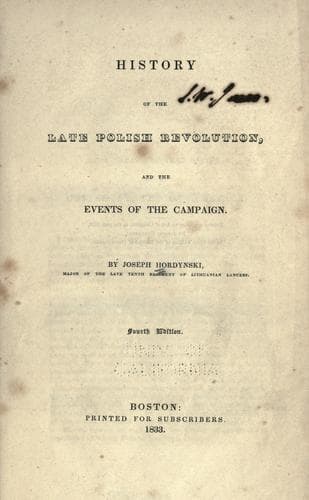
History of the Late Polish Revolution and the Events of the CampaignHordynski, Joseph
History
History of the Late Polish Revolution and the Events of the Campaign
Hordynski, Joseph
Poland -- History -- Revolution, 1830-1832
At 3 o'clock, our artillery received orders to evacuate their position,
and the skirmishers (_e_) were ordered to advance. On the cessation of
the fire of the artillery, the light troops commenced a warm fire upon
the columns of Russian infantry, which had already passed the bridge.
The enemy, profiting by the withdrawal of our artillery, commenced
repairing the bridge, to afford a passage for large masses of infantry,
and artillery. A strong Russian column (_f_), after passing the bridge,
took a direction to the left, to throw itself into the forest which
borders on the Narew, at the distance of a quarter of a league from
the bridge; and by occupying that forest and the communications which
traverse it, they thought to commence an attack upon our right wing.
To have permitted this would have much deranged our dispositions. The
Polish commander, observing that a great body of the Russian infantry
had already passed the bridge, and that this strong column had been
sent to occupy the forest, ordered general Lubinski to send forward a
brigade of cavalry (_g_), to charge upon this column, on its march, and
at the same time ordered general Kaminski, with a division of infantry,
to make a charge upon the Russian infantry near the bridge. These
two attacks were executed with great promptness and spirit, and were
successful. The column which the cavalry attacked on its march to the
forest, was dispersed with the loss of more than a hundred men left on
the field. The attack of the division of general Kaminski was equally
fortunate. The Russian columns, on receiving his charge, fell back upon
the bridge, or concealed themselves under the banks of the river. These
two attacks cost us the lives of the two generals, Kaminski and Kicki,
who threw themselves upon the enemy, at the head of their respective
columns. Their loss was deeply regretted by the army and the nation.
Although the result of these attacks was favorable to us, yet, the
general in chief, considering the terribly destructive fire of the
Russian artillery, which commanded the whole plain near the bridge,
decided that the repetition of them would cost us too severe a loss,
and commanded both the cavalry and infantry to withdraw to their former
position, and to cease firing.
Public-domain text, read in full here on John Shaqi.
Reviews
Reviews
No reviews yet
Be the first to share your thoughts on this work.
Elsewhere in the archive
Join the Discussion
Join the discussion
Sign in to leave a comment or review.
Sign InorCreate an account