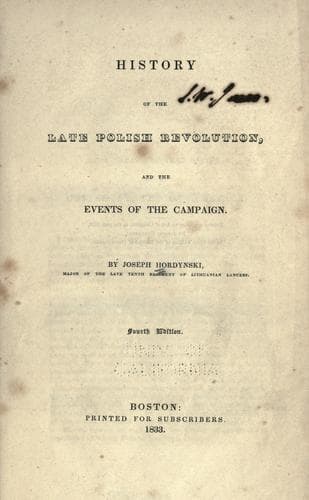
History of the Late Polish Revolution and the Events of the CampaignHordynski, Joseph
History
History of the Late Polish Revolution and the Events of the Campaign
Hordynski, Joseph
Poland -- History -- Revolution, 1830-1832
At 6 o'clock, the firing on both sides had entirely ceased. Profiting
by this interval, the Polish army pursued its route, and the Russian
infantry again commenced debouching upon the bridge. At dusk, nearly
the whole Polish army was on the march to Warsaw, and one division
only [_Plan_ XXXI, (_d_)] remained on our position. On the part of the
Russian army, we may suppose that nearly two divisions had passed the
bridge, when our general in chief, wishing to profit by the obscurity
of the night, in order to subject the enemy to still greater losses,
conceived the bold idea of advancing our artillery (_a_) so near the
Russian columns (_b_), as to pour upon them a fire of grape-shot.
General Skrzynecki himself approached colonel Boehm, and taking the
command of the twelve pieces of light artillery under him, led them
in person to the distance of within three hundred paces of the enemy,
and brought forward at the same time two regiments of cavalry for the
support of this artillery. Placing this little detachment in a very
advantageous position behind small elevations of ground, he commanded
colonel Boehm to commence firing. The Russian columns were thrown
into confusion by this unexpected and terrible fire; and it may be
imagined that their loss was immense, enclosed as they were within a
narrow space, on the bank and on the bridge. Every discharge of the
artillery was with effect, and by the testimony of the prisoners taken,
their loss must have amounted to an entire brigade, without estimating
those who left the field wounded, and those who fell into the river.
On our side, this attack cost us only the loss of two officers of the
artillery, although this detachment was exposed to the fire of the
whole Russian artillery.[63] Our battery fired but three rounds, when
the general gave the order to withdraw, and follow the main army (A) to
Warsaw.[64]
These are the details of the battle of Ostrolenka, in which the loss on
the enemy's side was from 10,000 to 15,000 men, and on our side, the
two general officers above mentioned, with about 4,000 men.
On the afternoon of the day of the battle of Ostrolenka, the division
of general Gielgud received orders to depart from the town of Lomza.
General Dembinski, on the night of the same day was ordered to join him
with two squadrons of lancers of Poznan. The latter general left the
field of battle with these squadrons, and on the next day joined the
division of general Gielgud.[65]
[Illustration:
_XXXI._]
[Illustration:
_XXXII._]
FOOTNOTES:
Public-domain text, read in full here on John Shaqi.
Reviews
Reviews
No reviews yet
Be the first to share your thoughts on this work.
Elsewhere in the archive
Join the Discussion
Join the discussion
Sign in to leave a comment or review.
Sign InorCreate an account