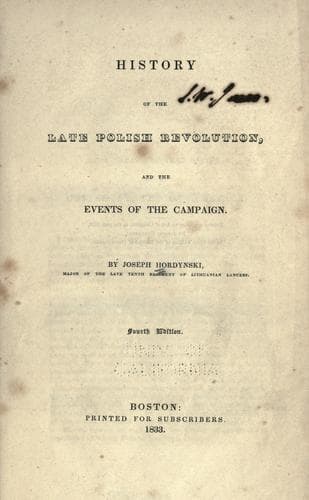
History of the Late Polish Revolution and the Events of the CampaignHordynski, Joseph
History
History of the Late Polish Revolution and the Events of the Campaign
Hordynski, Joseph
Poland -- History -- Revolution, 1830-1832
As it was from Zeymy that we commenced our operations upon Wilno,
after having organized the new forces; and as from this point begins
an era in the history of the expedition, it may be well to give a new
enumeration of our forces. Our infantry consisted of 13 battalions of
infantry, amounting in all to nearly 8,700 men, including a body of
sappers; our cavalry of 24 squadrons, amounting to about 2,750; and
our artillery of 29 pieces of cannon. To these forces we might add a
detachment of 500 men and 100 horse, acting independently as a corps
of partizans, under colonel Zaliwski. This corps of colonel Zaliwski
was formed in the duchy of Augustow, with the destination to operate
there upon all the demonstrations of the enemy, on his communications,
his magazines, his baggage, his transportations of provisions, &c; and
when it is considered that this officer remained for four months thus
successfully employed, and exposed to the enemy's forces on all sides,
a particular acknowledgment is due to him for his meritorious services.
In the above enumeration we have, of course, excluded the force of
general Szymanowski, which, as we have stated, received another
destination.
With the forces which we have enumerated, general Gielgud left Zeymy on
the 14th of June. The operations on Wilno were planned for an attack
on two sides, and with that view general Dembinski was detached with
a small corps (_d_) of 1,200 infantry, 900 cavalry, and 4 pieces of
cannon. This general was to attack Wilno on the road from Wilkomierz to
that city, at the same time that the larger force (_e_) made the attack
on the road from Kowno, on the left bank of the river Wiliia. This plan
demanded the most exact communication between the two attacking corps.
That communication was not observed, and, in fact, as it will be seen,
the plan itself was not executed.
The corps of general Dembinski reached Wieprz (4), on the river
Swieta, on the 14th of June. On the next day it passed that river,
and arrived at Szerwinty (5). From thence, after resting for a few
hours, the corps marched to Myszogola (6), where it passed the night.
On the 16th, leaving this village, after a march of two leagues, the
corps began to meet with small detachments of the enemy's Circassian
cavalry.[72] General Dembinski gave the order to throw forward the
flankers. The Circassians commenced a retreating fire, and, thus
engaged with them, we approached within a league of Wilno, taking a
position at Karczma-biskupia (7), or The Tavern of the Bishop, a large
public house, surrounded by small dwellings, and which was in rather a
commanding situation.
Public-domain text, read in full here on John Shaqi.
Reviews
Reviews
No reviews yet
Be the first to share your thoughts on this work.
Elsewhere in the archive
Join the Discussion
Join the discussion
Sign in to leave a comment or review.
Sign InorCreate an account