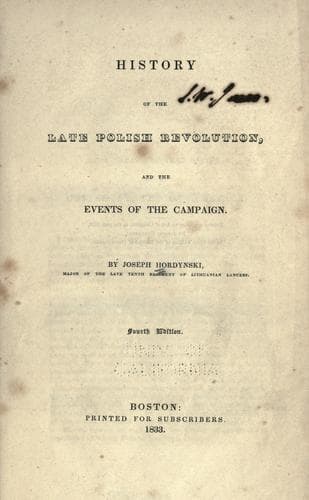
History of the Late Polish Revolution and the Events of the CampaignHordynski, Joseph
History
History of the Late Polish Revolution and the Events of the Campaign
Hordynski, Joseph
Poland -- History -- Revolution, 1830-1832
On the 17th, general Dembinski sent parties of cavalry to the right as
far as the river Wiliia (W), and to the left as far as Kalwaria (8),
to make reconnoissances, and advanced with the body of the corps in
the centre, for the same object. In these reconnoissances a constant
fire of flankers was kept up, with which the whole day was occupied.
It was a great fault in general Dembinski, to have commenced this
fire, without having any intelligence of the situation of the corps of
general Gielgud, with which he was to act in concert. On the morning of
the same day, in fact, on which general Dembinski was thus employed,
the corps of general Gielgud was at the distance of thirty-six English
miles from him. By these imprudent reconnoissances, general Dembinski
laid open all his forces to the knowledge of the enemy. Of this fault
the enemy took advantage on the next day.
On the 18th, at sunrise, clouds of Circassian cavalry made their
appearance, and commenced attacks upon our flanks, endeavoring to
turn them. Several columns of Russian infantry then approached,
and manoeuvred upon our centre, on which also 12 pieces of Russian
artillery of large calibre commenced firing. Other columns of cavalry
manoeuvred upon our wings. As far as we could judge, the enemy's forces
amounted to about 8,000 men. General Dembinski, seeing the strength of
the enemy, and appreciating his own danger, gave orders for a retreat,
which was commenced under a terrible fire from the enemy's artillery,
and from his flankers, who harassed us on every side. The retreat was
executed in the greatest order, as far as Myszogola, a distance of 12
miles from our position, with the loss only of some fifty cavalry. On
arriving at Myszogola, general Dembinski, concerned at receiving no
intelligence from general Gielgud, sent an officer with a report of
what had occurred. That officer found general Gielgud with his corps,
at Oyrany, occupied in making the passage of the Wiliia, at that
place. The report of general Dembinski, as we can assert from personal
knowledge, gave a faithful description of the occurrences of the
preceding days, and contained a request, that, in case he (Dembinski)
was expected to maintain the position in which he then was, general
Gielgud must send him reinforcements of infantry and artillery. The
report finished with the suggestion, that it would be, under all
circumstances, the course most expedient, to re-unite his forces with
those of general Gielgud. Upon the receipt of this report, to which
general Gielgud gave little attention, orders were sent to general
Dembinski to depart for Podbrzeze (9), eight miles to the left of the
road which leads from Wilkomierz to Wilno. The pretext of this order
was to attack Wilno on the side of Kalwaryi, and to pass the river
Wiliia at that point. Thus, instead of being allowed to unite his corps
with that of general Gielgud, as he had proposed, general Dembinski was
Public-domain text, read in full here on John Shaqi.
Reviews
Reviews
No reviews yet
Be the first to share your thoughts on this work.
Elsewhere in the archive
Join the Discussion
Join the discussion
Sign in to leave a comment or review.
Sign InorCreate an account