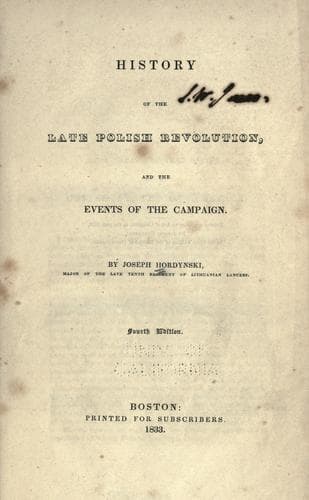
History of the Late Polish Revolution and the Events of the CampaignHordynski, Joseph
History
History of the Late Polish Revolution and the Events of the Campaign
Hordynski, Joseph
Poland -- History -- Revolution, 1830-1832
This separation of our forces in Lithuania, and, above all, this
designation of the most recently organized troops for the defence of
the passage of the two rivers, with a full knowledge of the great
strength of the enemy, was a gross error. To leave the defence of
Kowno, a place of so much importance, to three battalions of infantry
and a squadron of cavalry, all of them newly formed troops, and that,
too, without ammunition, (for they had barely three rounds each,) was
a course perfectly inexplicable. Besides all this, the river Swienta
was so shallow as to be fordable by both infantry and cavalry, and in
some places even by artillery. Why then was that river defended? It was
owing, in fact, to good fortune that all these detachments were not cut
off.
On the arrival of the two corps at Keydany and Wilkomierz, the
organization of a provisional government for the province, was
commenced. Diets were convoked at these two places, to organize
an administration, and to procure levies of forces. Although these
arrangements were all proper in themselves, yet it was a late hour to
undertake them, and no place could have been so well adapted for them
as Wilno. Had the corps of Saken been pursued and broken up, Wilno
would have been ours; and all such arrangements could have been made
there under the most favorable circumstances. In that event, the brave
Lithuanians would have come in from all sides and crowded our ranks,
without waiting for any appeal to be made to them. But at present,
a new crisis had arrived. We had fought the battle of Wilno with a
disastrous result. The enemy had become acquainted with the inferiority
of our forces, and had begun to understand the errors of our commander,
and was prepared to take advantage of them. In fine, the Lithuanians
themselves, witnessing all this gross mismanagement, became disgusted,
and after having once so cheerfully tendered their co-operation, began,
at length, to discover that they were sacrificing themselves in vain,
and that the fate of the inhabitants of Wilno would await them. This
people, as we have already stated, had commenced their insurrection two
months before they had hopes of any assistance from our forces, and
badly armed as they were, they had maintained a partizan warfare during
this period with uniform success. We can, therefore, have no reason
to reproach them, if after the misconduct which was exhibited before
their eyes, they began to be reluctant to join their forces to our
own, and chose to reserve the sacrifice of their exertions and their
lives for some other occasion, when there might be some hope of useful
results.
Public-domain text, read in full here on John Shaqi.
Reviews
Reviews
No reviews yet
Be the first to share your thoughts on this work.
Elsewhere in the archive
Join the Discussion
Join the discussion
Sign in to leave a comment or review.
Sign InorCreate an account