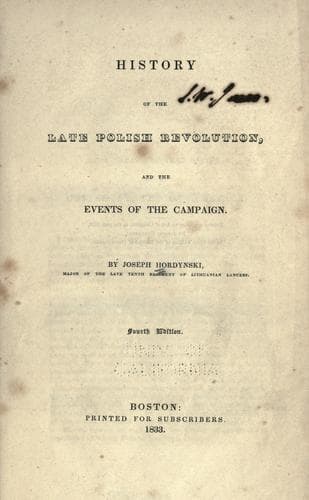
History of the Late Polish Revolution and the Events of the CampaignHordynski, Joseph
History
History of the Late Polish Revolution and the Events of the Campaign
Hordynski, Joseph
Poland -- History -- Revolution, 1830-1832
The six or seven days which we passed thus at Keydany and Wilkomierz,
seemed as if designed to invite the enemy to pursue his advantages,
and to lead him to the idea of surrounding our forces. The enemy,
fortunately for us, did not improve the opportunity which we presented
him, but remained inactive. This inactivity, whether it arose from the
imbecility of his commanders, or whatever other cause, afforded us an
opportunity of changing our plans, and of extricating ourselves from
the dangerous position in which we were placed. But instead of this,
we awaited his attack. On the 29th, the enemy commenced an attack upon
every point, at Wilkomierz, Wieprz, Janow, and Kowno, with his whole
force.
A corps of 4,000 Russians, with 16 cannon, commenced the attack on
Kowno, defended, as we have said, by 2,000 new troops. From morning
until night, the defence was sustained with great courage. The contest
was for the first half of the day in the town itself, and the rest
of the day was spent in disputing the passage of the bridge over the
Wiliia. The Russians occupying all the houses upon the banks of the
river, and the neighboring heights, commenced a terrible fire of
artillery and musquetry upon the bridge, which was defended by a
body of infantry, almost without ammunition. At nightfall, colonel
Kikiernicki, seeing that the Russian cavalry had found means of fording
the river, ordered a retreat, but remained himself at the head of a
single company, defending the bridge, until he learnt that the rest of
the corps had passed the town of Sloboda, and had gained the heights
which are behind the town. Upon that bridge, fell the captain of this
company, Zabiello, a Lithuanian. He was shot in the act of cutting
away the bridge with his own hands. This company, after having thus
sustained their post at the bridge with the greatest bravery, commenced
their retreat. The Russian cavalry, having succeeded in fording the
river, had already commenced acting in their rear. At the same time,
the Russian columns of infantry were debouching upon the bridge.
Colonel Kikiernicki, perceiving his situation, animated his little
corps to make the desperate effort of breaking through the Russian
cavalry, and of gaining Sloboda. His spirit was seconded by his brave
followers, and this company of one hundred men, raising the hurrah,
forced a passage through the enemy's cavalry, gained Sloboda, and,
under cover of night, succeeded in joining their comrades.[76] In this
effort, colonel Kikiernicki fell wounded, and was made prisoner by the
enemy.
The detachment, having lost one half of their numbers in the sanguinary
attack to which the mismanagement of our general had exposed them,
took the road to Janow. In this manner ended the attack on Kowno, and
the Russians took possession of that important post, which might be
regarded as the key to all our communications with Poland.
Public-domain text, read in full here on John Shaqi.
Reviews
Reviews
No reviews yet
Be the first to share your thoughts on this work.
Elsewhere in the archive
Join the Discussion
Join the discussion
Sign in to leave a comment or review.
Sign InorCreate an account