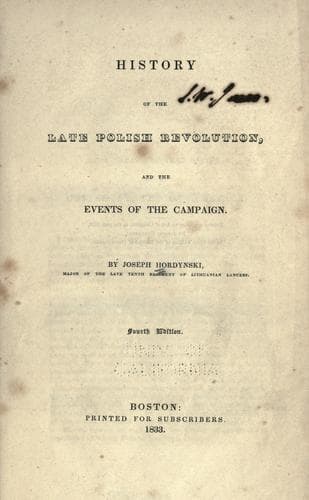
History of the Late Polish Revolution and the Events of the CampaignHordynski, Joseph
History
History of the Late Polish Revolution and the Events of the Campaign
Hordynski, Joseph
Poland -- History -- Revolution, 1830-1832
This battle discovered an extreme of negligence in our commander in
chief. With the knowledge that the enemy was pursuing us in the rear,
and on each side, we remained uselessly encamped during the night
of the 7th, which we ought to have employed in the attack. The true
course should have been to have set fire to the place, which would
have required only the agency of a few bold men. This town, indeed,
deserved no better fate; for it was inhabited almost exclusively by
hostile Jews. When the general welfare is at risk, there should be no
hesitation in sacrificing the convenience of individuals. If we compare
the consequences of having burnt this town, and of having attacked it,
we shall see that, by the former course, we should have compelled the
Jews to fly with their effects, and the Russian garrison to surrender,
without any effusion of blood, while, by attacking it, we lost nearly
one thousand men, without any advantage whatever.
In regard to the attack, the surrounding of the town was a great fault;
for neither the fire of the artillery nor of the light troops could
be effective, as the Russian artillery was in a dominant position,
and was concealed within the city, as their infantry was behind their
entrenchments. The skirmishers, in approaching the city, fell, without
having harmed the enemy. The plan of colonel Pientka, of masking the
attack on one side, and forcing the attack upon the other, at a single
point, was well conceived, but failed, as we have seen, by the want of
support.
At about ten o'clock the flanking parties of the Russian cavalry began
to show themselves on each side of us, upon the road to Wilkomierz, and
on that of Cytowiany. Our corps was already on the march for Kurszany.
The 1st regiment of lancers and the light artillery were designated
as a rear-guard. This rear-guard, taking advantage of a small defile,
which presented a favorable position, took post there, and sustained
themselves for some hours against an attack from the Russian advanced
guard; thus protecting the march of our main body, which was executed
with the greatest order. The lancers and light artillery then evacuated
their position, by a retreat at full speed, which, by taking advantage
of the windings of the road, and the vicinity of the forests, they were
able to effect with inconsiderable loss. On the evening of the same
day, we arrived at Kurszany. On the next day we remained some hours
in that place, to hold a council of war. General Chlapowski proposed
to divide our forces into three corps, each to act independently.
This arrangement was carried into effect, and our forces were thus
distributed.
The 1st corps, under general Chlapowski, with which general Gielgud
remained, consisted of five battalions of infantry, amounting to 1,500
men; four squadrons of the 1st regiment of lancers, and two squadrons
of Kaliszian cavalry; in all, 450 horse, and an artillery consisting of
13 pieces of cannon.
Public-domain text, read in full here on John Shaqi.
Reviews
Reviews
No reviews yet
Be the first to share your thoughts on this work.
Elsewhere in the archive
Join the Discussion
Join the discussion
Sign in to leave a comment or review.
Sign InorCreate an account