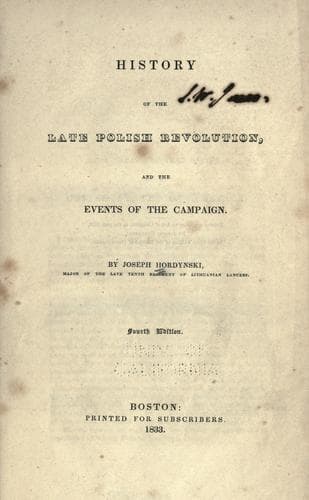
History of the Late Polish Revolution and the Events of the CampaignHordynski, Joseph
History
History of the Late Polish Revolution and the Events of the Campaign
Hordynski, Joseph
Poland -- History -- Revolution, 1830-1832
This corps received the destination, to march for Rosseyny, leaving the
enemy on the right, and from thence directly for Kowno, and, by this
unsuspected march, to surprise the last important position. By that
means, the communication between us and Poland would be re-opened; and
to protect this communication was to be the principal employment of
that corps.
The 2d corps, under the command of generals Rohland and Szymanowski,
was composed of eight battalions of infantry, amounting to about 3,000
men; all the cavalry which was recently formed in Lithuania, consisting
of nearly 1,000 horse; and an artillery, commanded by the brave colonel
Pientka, consisting of 12 pieces of cannon.
This corps was directed to march upon Polonga, a port on the Baltic.
It had been rumored that two French vessels with arms, funds, and
ammunition, together with a small body of volunteers, were cruising
near that port. After they should have received these expected
supplies, the corps was directed to march towards the Dwina, and, by
following along the banks of that river, to observe and interrupt the
communications between the forces of the enemy in Lithuania, and the
province of Courland.
The 3d corps, under general Dembinski, was composed of three battalions
of infantry of the 18th regiment, recently formed, consisting of about
1,000 men; two squadrons of the lancers of Poznan, two squadrons of
the lancers of Plock, and one squadron of the 3d regiment of Hulans,
in all, about 500 cavalry; and seven pieces of artillery. This corps
received orders to march for the environs of Szawla, traversing the
forests, and leaving the enemy on the right; from thence to take a
direction to Wilkomierz, and thence to the environs of Wilno, and to
attack that city, if circumstances might allow of it; and then to
manoeuvre in the department of Minsk, and in the forests of Bialystok,
acting there in support of the insurrection, and collecting the forces
of the insurgents. An important object of this corps was to support
a communication with the corps of general Chlapowski. This plan, the
reader will observe, was, in many of its points, the same with that
suggested by colonel Valentin.
Public-domain text, read in full here on John Shaqi.
Reviews
Reviews
No reviews yet
Be the first to share your thoughts on this work.
Elsewhere in the archive
Join the Discussion
Join the discussion
Sign in to leave a comment or review.
Sign InorCreate an account