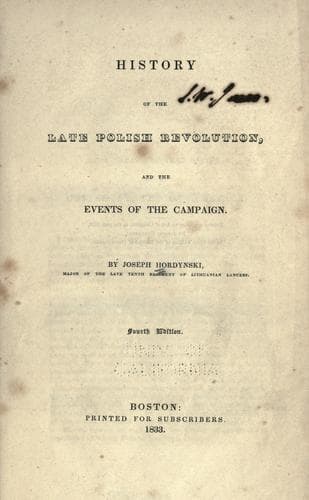
History of the Late Polish Revolution and the Events of the CampaignHordynski, Joseph
History
History of the Late Polish Revolution and the Events of the Campaign
Hordynski, Joseph
Poland -- History -- Revolution, 1830-1832
A proper reflection upon all these arrangements would convince any one
that much more loss than advantage was to be anticipated from them.
This subdivision of the force was, in fact, a visionary scheme. Many
officers openly declared their opinions to this effect, and urged that
in our critical situation, almost surrounded as we were by a hostile
force, so superior to our own, we ought not to form any new projects,
but, profiting by the concentration of our forces, to redouble the
rapidity of our march, and, taking advantage of the forests and covered
roads, to reach Poland as soon as possible. This would, indeed, be
attended with difficulties; but it would still be much easier of
execution, and much more proper to be attempted, than the plan which
we have detailed. Such views, however, were not regarded. The project
was highly colored, and the most brilliant successes were promised to
follow it. The separation of the corps was accordingly ordered, and our
fate was sealed.
FOOTNOTES:
[Footnote 76: With this company was the countess Plater, and her
aid-de-camp M'lle Rasynowiecz.]
[Footnote 77: The Jewish inhabitants of the city even fired upon our
soldiers. Many of them were taken with pistols in their hands, and
afterwards executed.]
[Footnote 78: In this affair we ought to make particular mention of the
estimable Laga, a priest, who was at the head of the squadron in this
attack, having the cross in one hand and the sabre in the other.]
CHAPTER XXIV.
The three subdivisions of the Lithuanian corps take their
respective destinations.--Details of the operations of that of
general Rohland.--He meets alone the attack of the whole Russian
force.--Battle of Powenduny and Worna.--General Rohland, on his
way to Polonga, learns that general Chlapowski had marched towards
the Prussian frontier.--He presses his march to overtake and form
a junction with him.--The greater part of the corps of Gielgud
and Chlapowski were found to have passed the frontier, when that
of Rohland came in sight.--Indignation of the soldiery.--Death of
general Gielgud.--General Rohland, joined by a portion of the corps
of Gielgud which had not yet passed the frontier, continues his march
to Nowe-Miasto.--He declines a proposition from general Kreutz, to
surrender.--Successful skirmish with the enemy's cavalry.--General
Rohland takes a position at Nowe-Miasto, and awaits the enemy.--The
Russian forces, however, do not continue their pursuit, but go into
camp.--Propositions to pass the frontier are sent to general Rohland
by the Prussian authorities.--They are submitted to the corps, and
accepted.
Public-domain text, read in full here on John Shaqi.
Reviews
Reviews
No reviews yet
Be the first to share your thoughts on this work.
Elsewhere in the archive
Join the Discussion
Join the discussion
Sign in to leave a comment or review.
Sign InorCreate an account