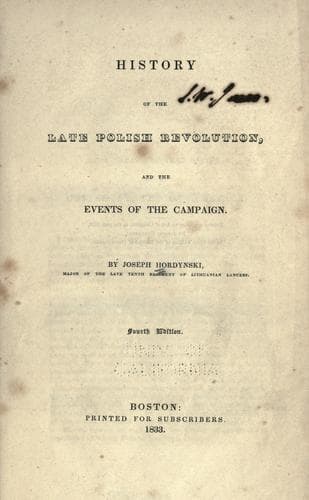
History of the Late Polish Revolution and the Events of the CampaignHordynski, Joseph
History
History of the Late Polish Revolution and the Events of the Campaign
Hordynski, Joseph
Poland -- History -- Revolution, 1830-1832
The battle commenced at sunrise, as we have already mentioned, with an
attack from two squadrons of Circassian cavalry. Those squadrons turned
our outer guard, and came in contact with our tirailleurs, who received
them with a warm and unexpected fire. These tirailleurs were concealed
in the forest and brush-wood. The Circassians halted, and commenced
a fire of carbines in return. Our fire could not but be attended
with great loss to the enemy, and they were forced to retire. In
this retreat, our own cavalry, which was at Powenduny, and which had
debouched by a covered road, and taken position, entirely surrounded
these two squadrons, and, attacking them on all sides, causing a severe
loss and taking forty prisoners. An hour after, the Russians renewed
the attack. Strong columns of infantry and cavalry passed through a
little village which is on the road from Kurszany to Powenduny. The
Russian artillery took positions upon the declivity of the heights
adjoining that village, and commenced a fire upon our cavalry. At the
same time, several columns of the Russian infantry threw themselves
into the brush-wood on the right of our position, while a strong
detachment, composed of infantry, artillery, and cavalry, was pushed
forward upon our right wing, with the design to turn our flank, and,
by surrounding us, to cut off our communications with Worna. This
detachment, after losing several hours in attempting to act upon us,
under the obstacles which were presented by the marshy nature of the
ground, returned without having effected any thing. Our generals,
seeing the superior force of the enemy, ordered our cavalry to retire,
and to place themselves in the rear of our artillery, which occupied
heights commanding the whole vicinity, and arrested by an incessant
fire, for more than four hours, the advance of the enemy. After our
cavalry had retired, the tirailleurs began to evacuate the wood, and
concentrating themselves upon the road to Powenduny, retired also,
after having destroyed the bridge which crosses a small marshy stream,
intersecting the road, and burnt a faubourg which adjoins Powenduny,
and was near this bridge. Such was the state of things when, at about
ten o'clock, a flag was announced from the Russian commander. It was
brought by an aid-de-camp of general Delinghausen. The proposition
borne by this flag was, that we should surrender, on the ground that we
were engaged with the whole of the Russian force, amounting to nearly
20,000 men, and that that force had already occupied the road to Worna,
the only communication which remained to us. This proposition was
followed by the usual considerations,--the wish to prevent the needless
effusion of blood, &c. It was declined, and the aid-de-camp returned
to the Russian head-quarters, but in a short time appeared again with
a renewal of the proposition. General Szymanowski, who received the
aid-de-camp, persisted in his refusal, adding, that 'he knew the duties
Public-domain text, read in full here on John Shaqi.
Reviews
Reviews
No reviews yet
Be the first to share your thoughts on this work.
Elsewhere in the archive
Join the Discussion
Join the discussion
Sign in to leave a comment or review.
Sign InorCreate an account