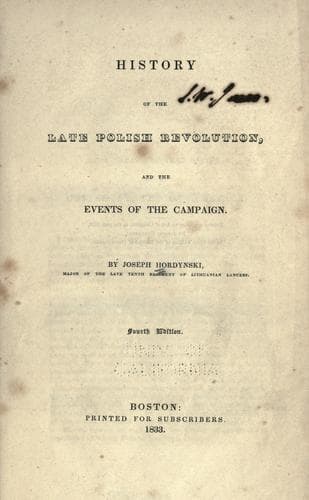
History of the Late Polish Revolution and the Events of the CampaignHordynski, Joseph
History
History of the Late Polish Revolution and the Events of the Campaign
Hordynski, Joseph
Poland -- History -- Revolution, 1830-1832
of a soldier--duties which were doubly obligatory upon one who is
fighting in the cause of liberty, and in the defence of the country of
his ancestors.' After the departure of the aid-de-camp, the order was
given to the artillery and infantry to re-commence their fire. At the
same time, arrangements were made for the continuation of our march to
Worna. At about mid-day, our columns of infantry, and a part of the
cavalry and artillery, quitted their position, and took up the march
for Worna. After a short time, there remained but one battalion of
infantry, and three squadrons of cavalry. The cavalry was employed to
mask the withdrawing of the remaining artillery. After our corps had,
by a march, arranged in the manner we have described, reached a point
sufficiently distant from our first position, the battalion of light
infantry which remained in that position was ordered to withdraw as far
as certain mills, keeping up a retreating fire. After passing those
mills, the tirailleurs received orders to run at full speed to rejoin
the corps, and to occupy the adjoining forests, while the cavalry
were ordered to take post at the mills, to cover this movement, and
afterwards to retire slowly, pass a small village which was on the
road, and on the opposite side of that village to await the approach of
the enemy. This manoeuvre was well executed by both the infantry and
cavalry, the latter placing themselves on rather an open space behind
the village, to await the enemy. After some time, six squadrons of the
light Russian cavalry, consisting of hussars and Circassians, passed
through the village, and seeing the small number of our cavalry, gave
the hurrah, and threw themselves upon them. Our cavalry, expecting this
attack, received orders to quit their position with promptness, in
order to lead the Russian cavalry upon the fire of our infantry, who
were concealed in the woods. The Russian cavalry, presuming that this
was a disorderly retreat, followed with impetuosity, while our cavalry
threw themselves on one side, to pass a ford which had been designated
for that object, and thus left the enemy exposed in a mass, to the fire
of our tirailleurs. The manoeuvre cost the Russians two hundred men, by
the acknowledgment of officers who were made prisoners. After having
caused this severe loss to the enemy, our infantry and cavalry retired
slowly, to occupy their third position, and the enemy did not follow.
Public-domain text, read in full here on John Shaqi.
Reviews
Reviews
No reviews yet
Be the first to share your thoughts on this work.
Elsewhere in the archive
Join the Discussion
Join the discussion
Sign in to leave a comment or review.
Sign InorCreate an account