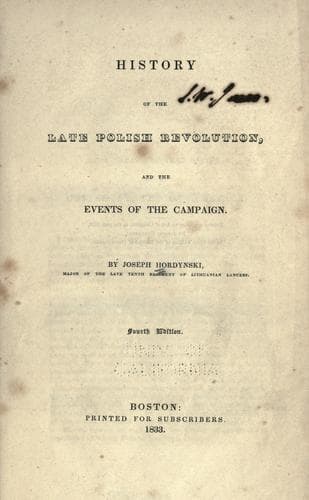
History of the Late Polish Revolution and the Events of the CampaignHordynski, Joseph
History
History of the Late Polish Revolution and the Events of the Campaign
Hordynski, Joseph
Poland -- History -- Revolution, 1830-1832
When our arrangements were completed, we heard the fire of the
two battalions composing our rear-guard, who were engaged, while
withdrawing, with the Russian infantry. Strong columns of the enemy's
infantry, which were following these battalions began to debouch from
the forest, and to deploy upon the plains before Worna. Those columns
were followed by the enemy's artillery, 12 pieces of which took post on
the side of the road, and immediately opened a fire upon our centre.
At the same time, a warm fire of skirmishers was commenced on each
side. Our artillery, which was very advantageously placed, without
replying to that of the enemy, opened a fire upon the columns of the
enemy's infantry. Before night, the whole Russian forces had deployed
upon the plain, and a powerful attack on their side was expected; but
instead of this we were astonished to find that their fire began to
slacken, perhaps owing to a heavy rain, which had just began to fall.
Our commander with the view to profit by this rain and the approach
of darkness, after an interval of not more than ten minutes, ordered
the two battalions which remained in the forests on our left, to make
a sudden charge with the bayonet upon the right wing of the enemy.
These battalions, under the command of the brave colonel Michalowski,
performed prodigies of valor in this charge, and bore down all before
them. Colonel Koss at the same time taking the command of the cavalry,
and addressing a few exciting words to them, led them upon the centre
of the enemy at the charge. The consternation of the Russians was
extreme. A great part of their cavalry was found dismounted, for they
had not the least expectation of an attack; their artillery fled,
and abandoned their cannon; the utmost disorder followed, and a vast
number of the enemy fell upon the field. According to the testimony of
prisoners, the consternation was at such a height that we might have
put their whole corps to rout. Our forces, however, could not follow up
these advantages; for the obscurity of the night and our own weakness
made it impossible. We were content with having reduced the strength of
the enemy by the great losses we had occasioned; and we continued our
route towards the seaport of Polonga, agreeably to our orders, where we
were looking for reinforcements, and where our generals believed that
the corps of general Chlapowski would join, and act with us upon some
new plan. On the morning of the 12th we arrived at Retow.
Public-domain text, read in full here on John Shaqi.
Reviews
Reviews
No reviews yet
Be the first to share your thoughts on this work.
Elsewhere in the archive
Join the Discussion
Join the discussion
Sign in to leave a comment or review.
Sign InorCreate an account