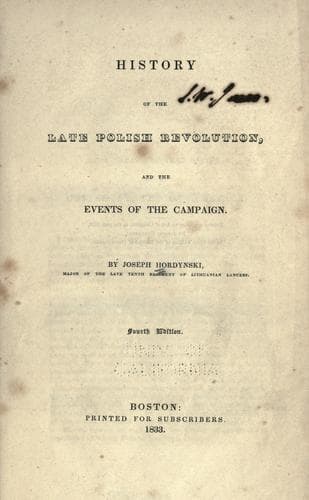
History of the Late Polish Revolution and the Events of the CampaignHordynski, Joseph
History
History of the Late Polish Revolution and the Events of the Campaign
Hordynski, Joseph
Poland -- History -- Revolution, 1830-1832
A short time after we quitted our second position, the Russian cavalry
showed themselves again. General Szymanowski remained, with two
companies of the 7th regiment of the line, to defend the passage of
the third village against the enemy, and to give time to our cavalry
to take a third position. This general, for nearly an hour, resisted
the attack of a strong force of cavalry, but commenced evacuating
the position on the approach of considerable bodies of the Russian
infantry, withdrawing through the forests. The Russian cavalry, seeing
that the village was abandoned by our infantry, began to debouch
through it. It was an act of the greatest imprudence in the Russian
cavalry, unsupported by either infantry or artillery, to advance thus
upon a plain surrounded by forests, in which they might have supposed
infantry, and even cavalry, to be concealed. Two squadrons of our
cavalry commenced a fire in order to harass them, and draw them on
to the middle of the plain. Afterwards, those two squadrons wheeling
about, laid open the Russian cavalry to the fire of our artillery,
which was posted on a little elevation and concealed by brush-wood.
This fire of our artillery was effective. The enemy's cavalry began
to waver. General Szymanowski observing this, ordered an immediate
attack by our whole cavalry, consisting of twelve squadrons. This
attack was made with great impetuosity. Sixteen hussars, with two
officers, were taken prisoners, and forty or fifty were left, killed
or wounded, on the field. After this, the corps recommenced its march
to Worna, leaving two battalions of the 7th regiment of infantry, as a
rear-guard, in the forests which border on that road.
The successes which we had thus obtained in our three first positions
were over the advanced guard of the enemy; but in the fourth position,
arranged by the brave and skilful colonel Koss, and in which our
successes were even greater, we had to encounter the whole body of
the Russian forces in Lithuania, which, according to some of our
prisoners, were to be estimated at 18,000, and by others at 25,000 men,
with 36 pieces of artillery, under the command of the several Russian
generals, Kreutz, Tolstoy, Szyrman, Delinghausen, and Saken. The town
of Worna is surrounded by two large lakes, in such a manner that the
only communication with that town to the west, is by a neck of land,
separating the extremities of those two lakes. The town is situated
upon an elevated ground, which overlooks the whole vicinity. On our
left wing was a forest, that reached one of the lakes. This forest was
occupied by two battalions of infantry. Our right wing leaned upon the
other lake. All our artillery remained in the centre, and occupied the
heights near Worna.
Public-domain text, read in full here on John Shaqi.
Reviews
Reviews
No reviews yet
Be the first to share your thoughts on this work.
Elsewhere in the archive
Join the Discussion
Join the discussion
Sign in to leave a comment or review.
Sign InorCreate an account