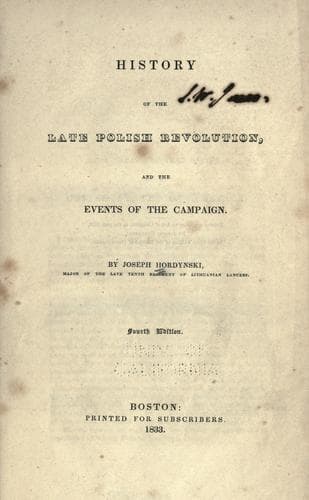
History of the Late Polish Revolution and the Events of the CampaignHordynski, Joseph
History
History of the Late Polish Revolution and the Events of the Campaign
Hordynski, Joseph
Poland -- History -- Revolution, 1830-1832
into the Prussian territory, and by that act the operations of the
Lithuanian corps were ended.
FOOTNOTES:
[Footnote 79: It might have been the case, that a few wagons with some
of the baggage of the corps, were sent in advance in the direction of
Polonga, merely as a precautionary arrangement.]
[Footnote 80: In this affair major the prince Giedroyc distinguished
himself at the head of his regiment, the 6th chasseurs, and killed with
his own hand the commander of the enemy's cavalry, an officer of the
rank of general.]
CHAPTER XXV.
Effect of the news of the Lithuanian disasters on the minds of the
people.--Distrust of the National Government.--The Russian army
resumes the offensive under general Paszkewicz.--He decides to
pass the Vistula.--Examination of the merits of this plan.--Plan
of general Skrzynecki to act on the different detached corps of
the enemy.--Advantages of general Chrzanowski over the corps
of Rudiger.--The Russian forces execute the passage of the
Vistula.--General Skrzynecki crosses the Vistula at Warsaw to operate
against the enemy on the left bank.--An inquiry into the conduct
of general Skrzynecki, and the appointment of a Council of War is
demanded by the nation.--Arrival of the corps of general Dembinski at
Warsaw.
While the nation was afflicted by the treasons at Warsaw, their hopes
had been still kept alive by looking towards Lithuania. What, then, can
express the disheartening effect produced by the intelligence that the
Lithuanian corps existed no longer;--that that pillar, so essential to
the support of the fabric we had been rearing, had fallen; and that
this disaster had been brought on by the gross negligence, if not
the treason, of those to whom that all-important expedition had been
entrusted. They felt that this was an almost mortal blow. They saw a
horrible future opening upon them, prepared by parricidal hands. After
such renewed outrages, the people fell into the greatest exasperation.
That people, whose confidence had been so basely abused, whose holiest
purposes had been so shamelessly sported with, seemed at last to
have changed their nature. So often betrayed, they lost confidence
in all, and seemed to see in every one a traitor. If, in the frenzy
of indignation, which such an experience had justified, they allowed
themselves to be carried away by their feelings, and to be guilty of
acts of severity, it can scarcely be wondered at.
Public-domain text, read in full here on John Shaqi.
Reviews
Reviews
No reviews yet
Be the first to share your thoughts on this work.
Elsewhere in the archive
Join the Discussion
Join the discussion
Sign in to leave a comment or review.
Sign InorCreate an account