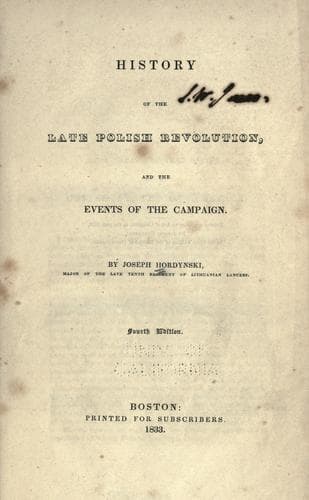
History of the Late Polish Revolution and the Events of the CampaignHordynski, Joseph
History
History of the Late Polish Revolution and the Events of the Campaign
Hordynski, Joseph
Poland -- History -- Revolution, 1830-1832
Immediately after the arrival of the sad news from Lithuania, the
nation demanded explanations of the generalissimo. They demanded to
know how he could have given the command of so important an expedition
to a man like Gielgud, one who had never been esteemed by the nation or
the army, and who had not even the reputation of a general of talent.
How could an expedition which demanded the very highest talents,
and the most undoubted patriotism, have been confided to a man like
him? With him had been associated general Chlapowski, who was the
brother-in-law of the Grand Duke Constantine. That circumstance alone,
they justly considered, should have been enough to suggest suspicion,
and to have at least indicated the expediency of keeping him near the
eye of the commander in chief, and subject to his constant observation.
Such were the complaints of the people, and they went to the heart of
the commander in chief, and the president of the National Government;
for they were conscious, but too late, of their justice.[81]
The Russian army, the command of which, on the death of general
Diebitsch, was taken by general count Paszkewicz, and the main body of
which remained in a state of inaction at Ostrolenka, having no longer
any apprehensions from Lithuania, could now act with freedom, and the
offensive was recommenced under the command of its new chief, who
decided to pass the Vistula, and to act upon the left bank.
I may be allowed to detain the attention of the reader a moment upon
this passage of the Vistula by Paszkewicz, a manoeuvre of which so
much boast has been made, and to consider whether it is really to be
regarded as a great and bold step, or one of necessity. What was the
state of the Russian army after the battle of Ostrolenka?--A month
had passed, and that army had not made a single movement, but was
kept there merely to be fed by Prussia. Was not this inactivity an
infallible evidence of weakness? Does it not show that, alarmed by the
prospects in Lithuania, it was in a state of hesitation, not daring to
advance into the kingdom, and holding itself in readiness to evacuate
it on an occasion of necessity, which indeed seemed near at hand? In
this period of hesitation, the new general arrives from the regions of
the Caucasus. He must do something. The question presents itself to
him,--what course is best to be taken? His army, now reinforced by the
corps which had been in Lithuania, amounted to perhaps near one hundred
and fifty thousand men. Although this force was considerable, yet to
attack the fortifications of Praga, which, as is known to the reader,
had been augmented, and which the Russian army in their primitive and
unimpaired strength had never had the temerity to attack, was out of
the question. What other course could he take, unless he could submit
to continue in this state of inactivity, but to pass the Vistula, and
under the assistance of Prussia, to make his attempts against Warsaw
Public-domain text, read in full here on John Shaqi.
Reviews
Reviews
No reviews yet
Be the first to share your thoughts on this work.
Elsewhere in the archive
Join the Discussion
Join the discussion
Sign in to leave a comment or review.
Sign InorCreate an account