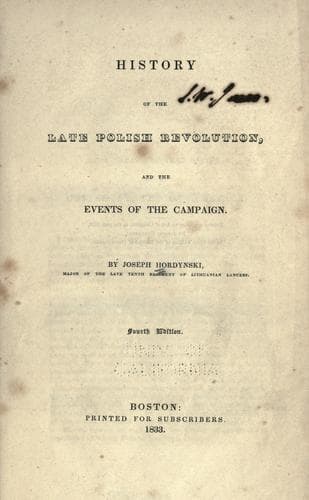
History of the Late Polish Revolution and the Events of the CampaignHordynski, Joseph
History
History of the Late Polish Revolution and the Events of the Campaign
Hordynski, Joseph
Poland -- History -- Revolution, 1830-1832
on the other side, a step, however, which he never would have dared to
have taken without that assistance. This is the natural explanation of
that boasted plan, in which we can see nothing but an almost necessary
movement, encouraged by a reliance on Prussia.
In the first days of the month of June the Russian army began to
approach the Vistula, in order to execute the passage. Their march
was in three principal columns, and was arranged in the following
manner:--general Witt, commanding the columns of the left wing, took
the direction of Sochoczyn. The centre, under marshal Paszkewicz, left
for Sonk and Luberacz, passing the river Wkra at Maluszyn. The column
of the right, consisting of the imperial guard, under the command of
the grand duke Michael, marched from Makow, by Ciechanow and Racionz.
General Pablen commanded the advanced guard. A considerable train of
ammunition, with provisions for twenty days, and a park of artillery
of reserve, formed the fourth column, and followed the imperial guard.
Detached posts towards Modlin and Serock, covered this march on the
left. One regiment of dragoons remained at Pultusk. This combined force
consisted of 80,000 men and three hundred pieces of cannon. Besides
these forces, there were in the kingdom, the corps of general Rudiger
at Kaluszyn, and that of general Rott at Zamosc. Those two corps might
now number about 20,000 men, and some thirty pieces of cannon. Opposed
to these forces, we had an army of 40,000 men, a hundred and twenty
pieces of cannon, not counting the national guard of Warsaw, and the
garrisons of the two fortresses of Modlin and Zamosc.
The plan of our generalissimo was to throw himself upon the detached
corps of the enemy, under Rott and Rudiger, and afterwards to act upon
his main body. For this end an attack was ordered upon the corps of
Rudiger, which was beaten in the environs of Minsk by the corps of
general Chrzanowski, in successive actions, on the 14th, 15th, and
16th of July. A third part of his corps being destroyed, a thousand
prisoners, four pieces of cannon and all his baggage taken, he was
forced to retire behind Kaluszyn. After these new advantages, the
general in chief prepared to act upon the rear of the Russian main
army, and to attack them while engaged in the passage of the Vistula,
which he supposed they would attempt either at Plock, or between Plock
and Modlin. But as he was afterwards apprized that the Russians were
to attempt the passage at a much more distant point from Warsaw, and
beyond his reach while on the right bank, he thought it most expedient
to pass the Vistula at Warsaw, and to operate against the enemy on the
other side. The Russian army thus passed the Vistula without being
intercepted, between the 12th and the 20th of July. Having reached the
left bank, the enemy took the direction of Lowicz, where, on the 27th,
the head-quarters of general Paszkewicz were established, and whither
our army marched to meet him.
Public-domain text, read in full here on John Shaqi.
Reviews
Reviews
No reviews yet
Be the first to share your thoughts on this work.
Elsewhere in the archive
Join the Discussion
Join the discussion
Sign in to leave a comment or review.
Sign InorCreate an account