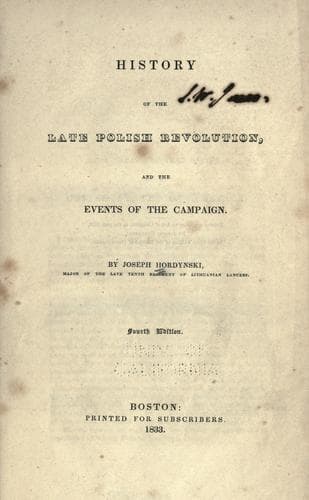
History of the Late Polish Revolution and the Events of the CampaignHordynski, Joseph
History
History of the Late Polish Revolution and the Events of the Campaign
Hordynski, Joseph
Poland -- History -- Revolution, 1830-1832
[Footnote 81: A few details of the history of the two generals who
were the cause of these fatal disasters, may gratify the curiosity of
the reader. General Gielgud was born in Lithuania, at Gielgudyszki,
(the place at which he crossed the Niemen in 1831). Passing over
his early life, which presents nothing noticeable, he commenced his
military career in 1812, when Napoleon entered Lithuania. In a moment
of patriotic fervor, he formed a small detachment at his own expense,
and joined the ranks of the supposed deliverer of Poland; and this
perhaps was the most praise-worthy act of his life. During the campaign
of 1812, 13, and 14, he was in no way distinguished either for good or
bad conduct. At the end of the Russian campaign, in 1815, he was made
colonel. As during that year, Poland came under the Russian government,
our army was subjected to a change of organization, and as many
officers of high rank, who were in independent circumstances, gave up
their commands, Gielgud then obtained the rank of general, at about the
age of thirty. This rapid advancement, as was natural to a man of weak
character, inspired him with an extreme of arrogance and pretension;
qualities which were encouraged in his intercourse with the Russian
generals, with whom he was much associated. It was this arrogance which
uniformly lost him the esteem of those under his command.
When the revolution broke out, general Gielgud was at the town of
Radom, and his life was in great danger from the suspicions of which he
was naturally the object, but he was protected by some of the patriots,
on the assurances which he gave of his patriotic dispositions. Still,
however, the military demanded his removal from his post, and, in fact,
for some weeks he was without command. The dictator, Chlopicki, whose
modes of action were, as the reader knows, too often inexplicable,
restored him to his command, persuading himself that he was one of the
best of patriots, and that if his exterior was offensive, he was right
at heart. In the war,--having first commanded a brigade, and afterwards
a division,--while he was attached to the grand army, his conduct was
not marked by any very great faults; indeed, in the battle of Minsk he
performed his part well. It was such occasional exhibitions of good
conduct which kept him in some consideration.
After having taken command of the corps of Lithuania, and when he was
removed from the observation of the army, he exhibited himself in his
true character. He was giddy with the distinction, and feeling himself
the absolute master of his own conduct, he gave himself up to all the
suggestions of his vanity.
Public-domain text, read in full here on John Shaqi.
Reviews
Reviews
No reviews yet
Be the first to share your thoughts on this work.
Elsewhere in the archive
Join the Discussion
Join the discussion
Sign in to leave a comment or review.
Sign InorCreate an account