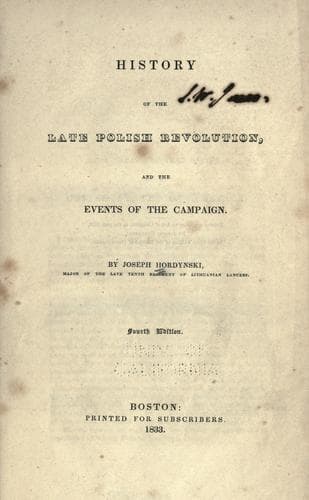
History of the Late Polish Revolution and the Events of the CampaignHordynski, Joseph
History
History of the Late Polish Revolution and the Events of the Campaign
Hordynski, Joseph
Poland -- History -- Revolution, 1830-1832
His first act of folly was to surround himself with a numerous suite,
(it was in number four times that of the commander in chief,) in which
suite those individuals were held in greatest esteem, who were most
fertile in resources for amusement. It was to this love of personal
gratification that we can attribute those delays which were sacrificing
the cause of the country. At Gielgudyszki the general gave a _fête_
to his officers; and it is not impossible that it was a motive of
mere personal ostentation which induced him to make the passage of
the Niemen, at that place, by which two days' march were given to the
retreating enemy, time was allowed him to concentrate his forces in
Wilno, and that capital was lost to us!
This general was never seen to share the privations, fatigues, and
exposure of his subalterns. In his personal deportment he neglected the
true means of gaining the confidence and attachment of his troops. On
the eve of a battle, in moments of danger and anxiety, it is cheering
to the soldier to see the face of his commander, and to hear from him a
few words of encouragement. These are apparent trifles, but they are in
reality of most serious consequence. They are the secret keys by which
every thing can be obtained from the soldier. The personal attachment
of the soldier to his commander, is worth more than the finest
combinations in strategy and tactics. The commander, who succeeds in
gaining the affection of the soldier, inspires him with a new impulse
for exertion. To his other motives is added the dread of forfeiting
the confidence and esteem of a friend; and perhaps, with the mass of
an army, such a motive would yield to no other in efficiency. To the
modes of conduct which would have secured this result, general Gielgud
was an entire stranger. Instead of freely approaching the soldier
and endeavoring to gain his attachment, he treated him with uniform
coldness and reserve. It is on the whole a matter of just surprise,
that a man with such glaring faults of character should have been
appointed to so responsible a trust.
Public-domain text, read in full here on John Shaqi.
Reviews
Reviews
No reviews yet
Be the first to share your thoughts on this work.
Elsewhere in the archive
Join the Discussion
Join the discussion
Sign in to leave a comment or review.
Sign InorCreate an account