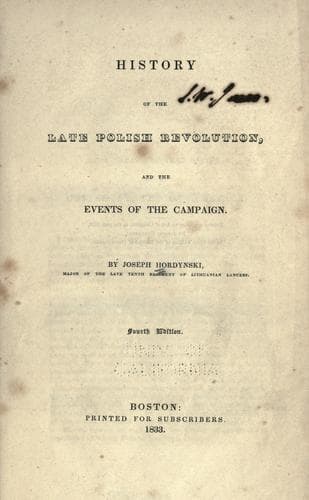
History of the Late Polish Revolution and the Events of the CampaignHordynski, Joseph
History
History of the Late Polish Revolution and the Events of the Campaign
Hordynski, Joseph
Poland -- History -- Revolution, 1830-1832
'For a long time a distinct power, and governed by its Grand Dukes,
united for the first time with Poland in the year 1386, and making,
in 1569, an integral part of the republic of Poland, Lithuania, from
that epoch, to that of 1795, formed, in the political state, the
third province of Poland; being composed of the palatinates of Wilno,
of Troki, the duchies of Starostia, and Samogitia, of Nowogrodek,
of Brzsclitewski, of Minsk, of Polock, of Witepsk, Mscislaw and of
Smolensk. The Grand Duchy was bounded on the north by Courland,
Semigallia, Polish Livonia, and the province of Great Nowogorod;
on the east by Moscovy; on the south by the Ukraine, Volhynia, and
the country of Chelme; on the west, by the Baltic Sea, the duchy of
Prussia, and the palatinates of Podlasia and Lublin. Its arms were
a cavalier at full speed, with a sabre raised over his head. This
cavalier of Lithuania, joined with the white eagle of Poland, figured
inseparably upon the arms of the republic, upon the national standards,
the public edifices and the coins, up to the moment when foreign force
and domestic treason struck a liberticide blow at that union which
ages has consecrated. In 1812, for a moment, those fraternal arms
were united; but separated again, they once more floated upon every
banner after the memorable date of the 29th of November. According to
ancient traditions, towards the year 900, there landed on the coast
of Samogitia, between Memel, Polonga, and Libau, a colony of Italians
who introduced into that country a certain degree of civilization,
and from thence came that multitude of Latin words which are to be
remarked in the Lithuanian language. From these Italian families, arose
several sovereign dynasties, which governed Lithuania and Samogitia. Of
this origin were, without doubt, the Gerules or Herules, who formerly
governed Lithuania. This people is the same which in the fifth century
invaded Italy, with Odacre, and returning on their steps, spread
themselves upon the shores of the Baltic, which embrace, at the present
day, Oriental Prussia, Lithuania, Samogitia, and Courland.
Public-domain text, read in full here on John Shaqi.
Reviews
Reviews
No reviews yet
Be the first to share your thoughts on this work.
Elsewhere in the archive
Join the Discussion
Join the discussion
Sign in to leave a comment or review.
Sign InorCreate an account