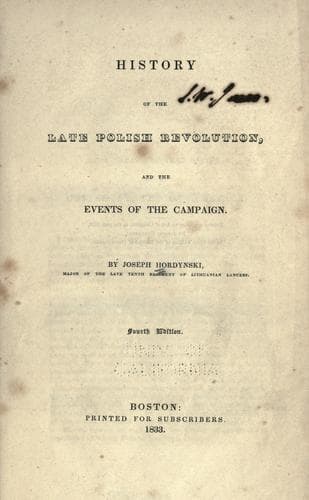
History of the Late Polish Revolution and the Events of the CampaignHordynski, Joseph
History
History of the Late Polish Revolution and the Events of the Campaign
Hordynski, Joseph
Poland -- History -- Revolution, 1830-1832
'The Lithuanians, though subjugated first by the Russians, did not
fail to make their strength soon felt by their invaders. In the 13th
century, when the Tartars ravaged on one side the Russian States, the
Lithuanians on the other side took possession of Grodno, Brzesc, and
Drohyczyn, and did not stop till they reached the banks of the Prypec
and the town of Mozyr. In the north their victorious arms were pushed
as far as the Dwina, and the city of Polock. In the year 1220, the
Russians, under Mscislaw-Romanowicz, declared war upon Lithuania, but
they were beaten near the river Tasiolda, and the Lithuanians augmented
their possessions by the occupation of Pinsk and Turow. Ringold was
the first who took the title of Grand Duke of Lithuania, in 1235.
Mindowe or Mendog, having promised the Pope to embrace the Christian
religion, was crowned king of Lithuania in 1252, at Nowogrodek; but
this did not continue long, for Mindowe, finding himself deceived,
returned to Paganism, and died in 1263. From 1280 to 1315, the dukes
Latuwer and Witènes reigned over this country; but the greatest power
of Lithuania dates from the fourteenth century, when Gédymin seized the
reins of government. Impatient to crush the Russian power, which had
distressed Lithuania, this prince defeated the enemy in 1320, upon the
river Pirna, made himself master of Volhynia, of Küovie, of Sewerie,
of Czerniechovia, and extended his boundaries as far as Putiwel upon
the Diésna. In 1340, when Gédymin perished upon the field of battle by
the hands of the Teutonic knights, the Tartaro-Russian power commenced
ravaging Polodia, but Olgerd, successor of Gédymin, came to the succor
of his nephews, Koryatowicz, who were in possession of that province,
defeated the Czars of the Tartars in a pitched battle, and extended the
territory of Lithuania as far as the banks of the Don and the Black
Sea. To form an idea of the extent of the Lithuanian provinces, it is
sufficient to point out here the partition between the sons of Gédymin:
Monwid possessed Kiernow and Slonim; Narymond--Pinsk, Mozyr, and a part
of Volhynia: Olgerd--Krewo, the ancient capital of the duchy, and all
the country as far as the Berezina; Kieystat--Samogitia, Troki, and
Podlachia: Koryat--Nowogrodek and Wolkowysk: Lubar--Wlodgimierz, with
the rest of Volhynia: Jawnat--Wilno, Osmiana, Wilkomierz, Braslaw. The
last succeeded first to his father, but after his death it was Olgerd
who took the reins of government.
Public-domain text, read in full here on John Shaqi.
Reviews
Reviews
No reviews yet
Be the first to share your thoughts on this work.
Elsewhere in the archive
Join the Discussion
Join the discussion
Sign in to leave a comment or review.
Sign InorCreate an account