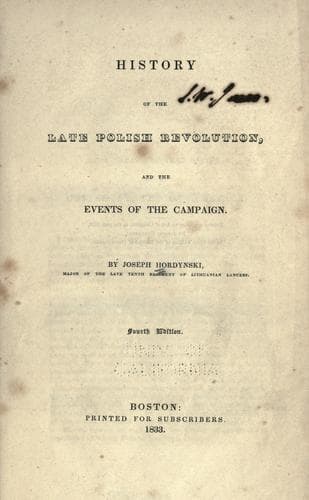
History of the Late Polish Revolution and the Events of the CampaignHordynski, Joseph
History
History of the Late Polish Revolution and the Events of the Campaign
Hordynski, Joseph
Poland -- History -- Revolution, 1830-1832
'At the epoch of the regeneration of Poland, the Lithuanians gave the
most convincing proofs of their devotedness to the Polish cause, in
the last years of the existence of Poland. In effect, when they became
satisfied that, for the common interest, and to give more consistency
to the new form of government which it was proposed to establish,
at the Diet of 1788, it was necessary to strengthen still more the
relations between Lithuania and the crown; that is to say, between
Little and Great Poland, so as to form out of the three provinces a
single powerful state, and to obliterate totally all the distinctions
which had before existed between the Poles and the Lithuanians, they
made a voluntary sacrifice of the privileges which they had held with
great pertinacity, and renounced, without hesitation, that of having
a separate army and treasury, consenting to unite themselves under a
single administration with the two other provinces.
'The whole world was witness to the heroism which the Lithuanians
displayed in the glorious confederation of Bar, from 1768 to 1772;
in the campaigns of 1792 and 1794, against foreign rapacity, when
Kosciuszko, a Lithuanian by birth, covered with imperishable laurels
the chains of Poland. The Lithuanians fell, but they fell with the
whole of Poland, and were buried in the common ruin. How nobly have
not the Lithuanians been seen to figure among the brave Polish
patriots, who sought in France, in Italy, and in Turkey, some chances
of restoration for a country which had been the victim of foreign
ambition! And how many of them have not been found under the banners
of Dombrowski, in Italy, and under those of Kniaziewiez, upon the
Danube? Have we not seen, in the years 1806 and 1809, twelve thousand
Lithuanians, united with their brethren, the Volhynians, the Podolians,
and the Ukranians, hastening to range themselves under the banners of
the army of the Grand Duchy of Warsaw? In 1812, their joy was extreme,
when they thought that their political existence was, at last, about to
be renewed. Then was seen the cavalier of Lithuania, united with the
white eagle, decorating the flags planted on the walls of Wilno. But
the disastrous retreat of the French army struck a mortal blow to the
destinies of those countries. The kingdom of Poland was proclaimed in
1815; the Diets of Warsaw, of 1818, 1820, and 1825, preserved silence
respecting the lot of the Grand Duchy of Lithuania. A look full of
hope from all Lithuania was turned once more towards Warsaw, upon the
24th of May, 1829, the day of coronation of Nicholas the 1st, but the
reunion of Lithuania was not even made a question of.'
[_Tableau de la Pologne, ancienne et moderne, par Malte Brun, edition
refondue et augmentee par Leonard Chodzko. Paris, 1831._ pp. 288-295.
Tom. I.]
No. II.
ADDRESS OF THE NATIONAL GOVERNMENT OF POLAND TO THE INHABITANTS OF
LITHUANIA, VOLHYNIA, PODOLIA, AND UKRAINE.[85]
_Brethren, and Fellow Citizens!_
Public-domain text, read in full here on John Shaqi.
Reviews
Reviews
No reviews yet
Be the first to share your thoughts on this work.
Elsewhere in the archive
Join the Discussion
Join the discussion
Sign in to leave a comment or review.
Sign InorCreate an account