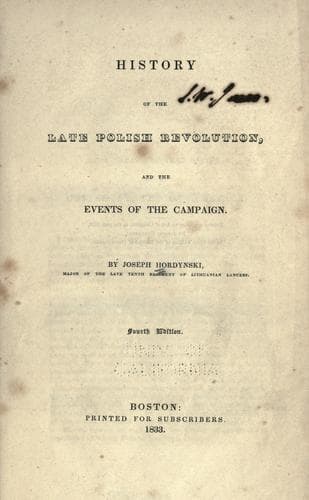
History of the Late Polish Revolution and the Events of the CampaignHordynski, Joseph
History
History of the Late Polish Revolution and the Events of the Campaign
Hordynski, Joseph
Poland -- History -- Revolution, 1830-1832
successor of Wladislay, was reigning still with eclat; when the
moment approached, at which from one side the Ottomans began to take
possession of the Tauride, while a new Muscovite power, subjugating the
Russians from the north and east, were soon to contract the frontiers
of Lithuania.
'All this, however, could have no effect upon the union of the two
nations, which daily acquired new strength; for, subsequently to the
first union of 1386, a Diet, in 1413, held in the bourg of Horoldo,
having declared the Lithuanians to be on an equal footing with the
Poles in regard to taxes and laws, many Lithuanian families allied
themselves with Polish families; in fine, the arms of the two nations
were united. It was then determined that the Lithuanians should receive
their grand duke from the hands of the king of Poland, and that,
when the latter should die without children or descendants worthy to
succeed him, the Poles should elect their new king conjointly with the
Lithuanians. The alliance concluded in 1413, was renewed in 1499; and
it was added, explicitly, that the Lithuanians should not elect their
grand duke without the concurrence of the Poles, nor the Poles their
king, without that of the Lithuanians. In 1561, the knights militant
submitted themselves, and the part of Livonia which remained with them,
to the domination of the king of Poland, as grand duke of Lithuania;
the new duke of Courland became also his feudatory. In fine, in 1569,
under Sigismond-Augustus, the Poles and Lithuanians held a Diet at
Lublin, in which the grand duchy was limited to the kingdom of Poland,
so that they thereafter formed but one body, subject to one prince, who
was conjointly elected by the two nations, under the double title of
king of Poland and grand duke of Lithuania. It was agreed, also, that
the Diet should be always held at Warsaw, that the two people should
have the same senate, the same chamber of deputies; that their coins
should be of the same designation; that, in fine, their alliances,
their auxiliary troops, and every thing, should be in common. The
campaigns of Moskow under Sigismond III, Wladislaz IV, and Etienne
Batory, amply proved that the Lithuanians were worthy of calling the
Poles brethren; for they were found ready for every sacrifice, when
the general good of the country was in question. In the laws of 1673,
1677, and 1685, it was ruled that each third Diet should be held in
Lithuania at Grodno; the Diets of convocation, and of election and
coronation were excepted, however, from this rule. In 1697, the Polish
and Lithuanian laws received an equal force and authority.
Public-domain text, read in full here on John Shaqi.
Reviews
Reviews
No reviews yet
Be the first to share your thoughts on this work.
Elsewhere in the archive
Join the Discussion
Join the discussion
Sign in to leave a comment or review.
Sign InorCreate an account