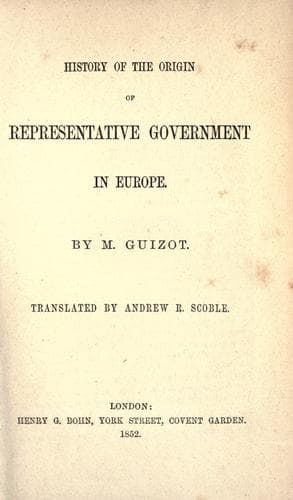
History of the Origin of Representative Government in EuropeGuizot, François
History
History of the Origin of Representative Government in Europe
Guizot, François
Europe -- History; Representative government and representation
The word _alode_, then, was probably applied at first only
to the lands taken by the victors in virtue of their conquests.
Another proof of this is that allodial property, properly so
called, was long distinguished from the lands held also in
absolute right, and entailing no acknowledgment of a superior,
but which had been acquired by purchase or in any other way. A
distinction was also made among allodial lands, of _salic_
land, which could be inherited only by males. This was probably
the original allod, the land acquired at the time of the
conquest, and which thereupon became the primitive and principal
establishment of the head of the family. _Terra salica_ is
the _terra aviatica_ of the Ripuarian Franks, the _terra
sortis titulo adquisita_ of the Burgundians, the
_hæreditas_ of the Saxons, and the _terra paterna_ of
the formulas of Marculf.
{107}
Salic Land.
Various explanations have been given of the term _salic
land_. Montesquieu thinks that it was the land belonging to
the house, from the word, _sal_, hall. This explanation is
supported by Hullmann. It would thus be the _in-land_ of the
Anglo-Saxons. It is probable that originally the _terra
salica_ was in fact the land connected with _the_ house,
the residence of the chieftain. The two explanations would thus
coincide; but the former is more complete and historical than the
latter.
The name of _allod_ was extended by degrees to all lands
possessed in absolute right, and held from no superior, whether
they were the original allods or not. The words _proprium,
possessio, prædium, hæreditas,_ were then employed as synonyms
of _allodium_. It was probably at this period also that the
rigorous interdict which excluded females from succession to
salic land, fell into desuetude. It would have been too harsh to
exclude them from succession to all allodial property. There were
some doubts entertained on this point as early as the time when
the salic law was drawn up; and Marculf has transmitted to us a
formula which proves that, although it was the common law to
deprive females of all succession to primitive allods, a father
might, nevertheless, by his will, give his daughter an equal
share with his sons in the division of all his property, of
whatever nature.
The essential and primitive characteristic of the
_allodium_, consisted in the absoluteness of the property;
the right to give it away, to alienate it, to bequeath it by
inheritance or will, &c. Its second characteristic was that it
depended upon no superior, and involved no service or tribute of
any kind to any individual. But although allodial lands were
exempt from all private charges towards individuals, does it
follow that they were also exempt from all public charges as
regarded the state, or the king as head of the State? This
question has been differently answered by learned men.
Public-domain text, read in full here on John Shaqi.
Reviews
Reviews
No reviews yet
Be the first to share your thoughts on this work.
Elsewhere in the archive
Join the Discussion
Join the discussion
Sign in to leave a comment or review.
Sign InorCreate an account