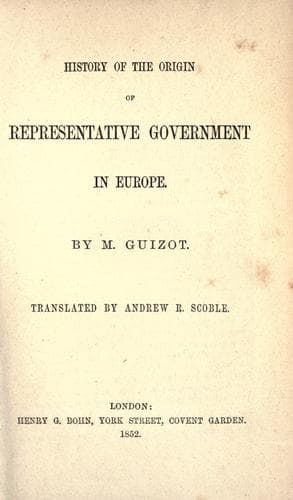
History of the Origin of Representative Government in EuropeGuizot, François
History
History of the Origin of Representative Government in Europe
Guizot, François
Europe -- History; Representative government and representation
At the period to which we allude, there were no public charges
properly so called, no obligations imposed and fulfilled as
regarded the State, or its head. All was limited to personal
relations between individuals; and from the relations of man with
man arose the mutual relations of landed property, which were not
carried further than those of persons.
{108}
Charges On Allodial Lands.
We have already seen this; the position of the Franks after the
conquest resulted from the combination of their anterior
relations with their new position. The freeman, who held his land
from no one, had no obligations or charges to fulfil to any one
on account of his land. In such a state of civilization, liberty
is the appanage of force. The Franks who possessed allodial
lands, and were strong enough to be under no obligation of duty
to any more powerful individual, would not have comprehended the
necessity of owing service to an abstract being like the State,
with which, moreover, they had no personal relation.
However, as society cannot exist in such a state of dissolution,
arising from the isolation of individuals, new relations were
progressively formed between the proprietors of allodial lands,
which relations imposed certain charges on them.
1st. The gifts presented to the kings either at the holding of
the Champs de Mars or Mai, or when they come to pass any time in
any particular province. The kings had no fixed habitation. These
gifts, though at first purely voluntary, became gradually
converted into a sort of obligation, from which allodial lands
were not exempt. That these gifts had become obligatory is proved
by a list drawn up at Aix-la-Chapelle in 817, during the reign of
Louis the Debonnair, which enumerates the monasteries which had
to pay them, and those which had not.
2nd. The supply of provisions and means of transport to the
king's ambassadors, and to the foreign envoys, on their passage
through the country.
3rd. Of the various barbarian nations which were successively
incorporated into the kingdom of the Franks, several paid tribute
to the Frankish kings; and of this tribute it is probable that
the free or allodial lands, possessed by these nations,
contributed their share. It consisted of a certain number of
cows, hogs, and horses. The nature of these tributes proves that
they were not distributed among the lands, but imposed upon the
nation as a whole.
4th. A more important charge, namely, military service, was
imposed upon allodial lands. In our next lecture, we shall see
how this charge was introduced.
{109}
Lecture XIII.
Origin of military service; its cause and limits.
It was made a general obligation by Charlemagne.
Allodial lands were originally exempt from taxation.
Origin of benefices.
Change in the position of the German chiefs in consequence of
their territorial settlement.
Their wealth.
No public treasury.
The _œrarium_ and _fiscus_ of the old Roman republic.
Public-domain text, read in full here on John Shaqi.
Reviews
Reviews
No reviews yet
Be the first to share your thoughts on this work.
Elsewhere in the archive
Join the Discussion
Join the discussion
Sign in to leave a comment or review.
Sign InorCreate an account